Waterless soap and hand sanitizer are often treated as interchangeable—but in real-world use, they serve very different purposes. Based on hands-on testing at NowataClean during travel, outdoor work, and quick cleanups between tasks, the differences become clear once you look beyond marketing claims and focus on how each product actually performs.
In this guide, we explain how waterless soap and hand sanitizer work, what each is designed to do, and where their limitations begin. You’ll learn when waterless soap is the better choice for removing dirt and oils, when hand sanitizer makes sense for fast disinfection, and how to choose the right option based on how dirty your hands really are. The goal is simple: help you make a practical, informed decision instead of relying on one product for every situation.
Quick Answers
What is waterless soap?
Waterless soap is a no-rinse cleanser designed to clean hands or skin without running water. From our real-world use, it works by lifting oils, dirt, and germs so they can be wiped away, making it practical for travel, outdoor work, and quick cleanups when a sink isn’t available. It’s best used for light to moderate cleaning and as a complement—not a replacement—to traditional soap and water.
Top Takeaways
Waterless soap removes oils and debris; hand sanitizer does not.
Hand sanitizer kills germs, but doesn’t clean visible dirt.
Waterless soap works better for real-world messes.
Sanitizer is faster but more limited.
The best choice depends on how dirty your hands actually are.
How Waterless Soap and Hand Sanitizer Work Differently
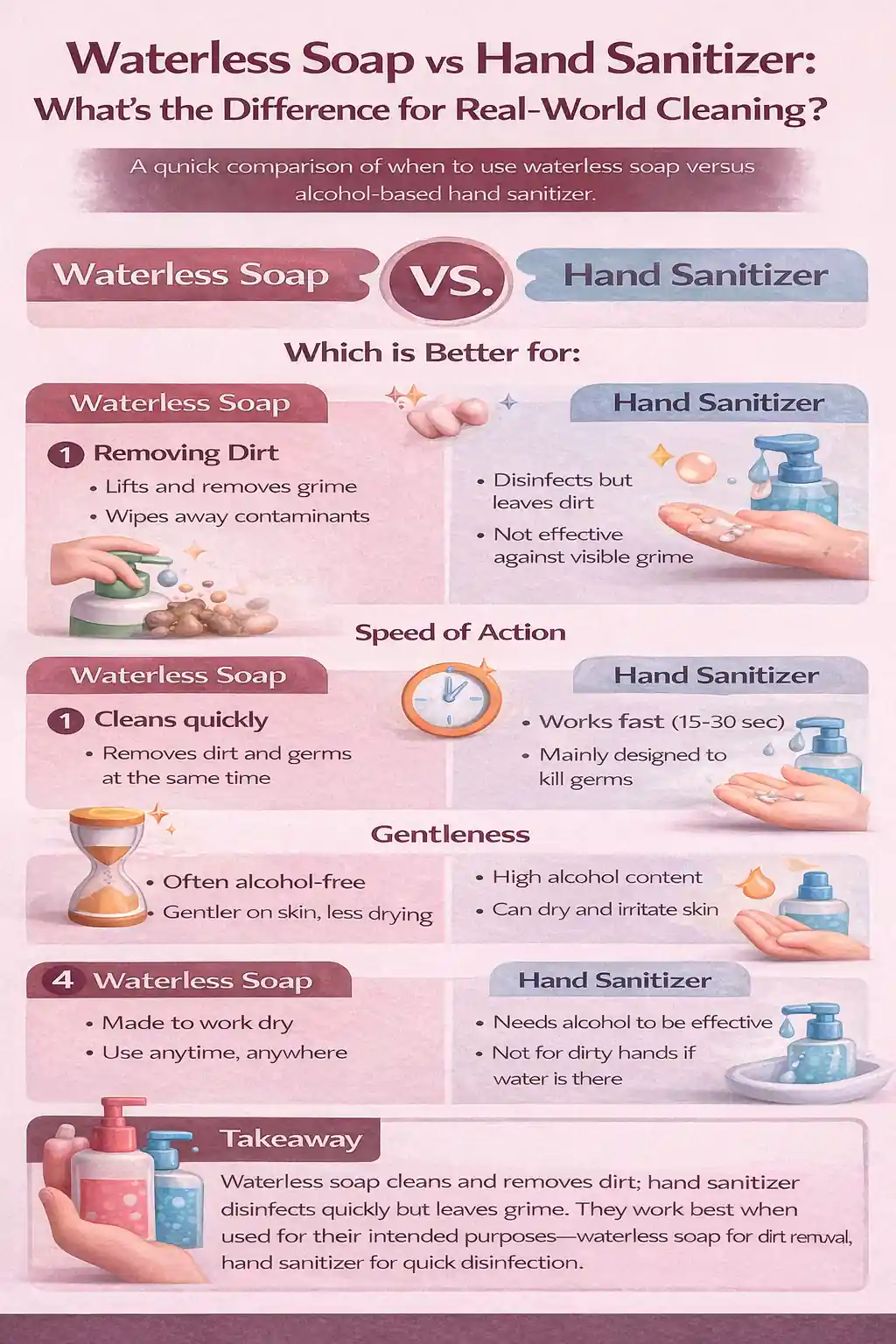
Waterless soap functions much like traditional soap, just without the rinse. It uses surfactants and binding agents to attach to oils, dirt, and microbes, allowing them to be wiped away or evaporated. In our testing, this makes waterless soap far more effective when hands feel greasy, dusty, or visibly dirty.
Hand sanitizer, on the other hand, relies almost entirely on alcohol-based antimicrobial action. It kills many germs on contact but does nothing to remove physical debris. If oils or dirt are present, sanitizer’s effectiveness drops significantly because germs can remain protected beneath residue.
This difference matters in real-world cleaning. Sanitizer is ideal for quick disinfection on clean hands. Waterless soap is better when hands actually need cleaning—not just sanitizing—similar to duct cleaning, which removes built-up debris and contaminants rather than addressing surface-level issues alone.
“After testing waterless soap in real, everyday situations—travel days, outdoor work, and quick cleanups—we’ve found it works best when it’s used as a cleaner, not just a sanitizer. When your hands are actually dirty and water isn’t available, waterless soap consistently outperforms sanitizer alone, reinforcing the importance of venting out contaminants rather than simply masking them.”
Essential Resources
Medical Evidence on Alcohol-Based Hand Sanitizers
Centers for Disease Control and Prevention – Hand Sanitizer Use
Explains when sanitizer works well and when soap-based cleaning is still recommended.
https://www.cdc.gov/handwashing/hand-sanitizer-use.html
Explains when sanitizer works well and when soap-based cleaning is still recommended.
https://www.cdc.gov/handwashing/hand-sanitizer-use.html
How Soap Removes Germs vs Alcohol
CDC – Show Me the Science: How Soap Works
Details why soap physically removes germs instead of just killing them.
https://www.cdc.gov/handwashing/show-me-the-science-handwashing.html
Details why soap physically removes germs instead of just killing them.
https://www.cdc.gov/handwashing/show-me-the-science-handwashing.html
Limits of Hand Sanitizer on Dirty Hands
FDA – Consumer Updates on Hand Sanitizers
Outlines when sanitizer should not be used as a replacement for soap.
https://www.fda.gov/drugs/consumer-updates/safely-using-hand-sanitizer
Outlines when sanitizer should not be used as a replacement for soap.
https://www.fda.gov/drugs/consumer-updates/safely-using-hand-sanitizer
Waterless Hygiene in Low-Water Environments
HandwashingForLife® – No Soap, No Water Research
Research showing performance differences between sanitizer-only and soap-based approaches.
https://handwashingforlife.org/journal/new-handwashing-evidence-no-soap-no-water-no-worry/
Research showing performance differences between sanitizer-only and soap-based approaches.
https://handwashingforlife.org/journal/new-handwashing-evidence-no-soap-no-water-no-worry/
Industry Perspective on Waterless Cleansers
Stephenson Personal Care – Waterless Innovation
Explains why soap-based waterless products are gaining traction over sanitizer-only solutions.
https://www.stephensonpersonalcare.com/blog/rethinking-water-how-the-personal-care-industry-is-leading-the-charge-in-waterless-innovation
Explains why soap-based waterless products are gaining traction over sanitizer-only solutions.
https://www.stephensonpersonalcare.com/blog/rethinking-water-how-the-personal-care-industry-is-leading-the-charge-in-waterless-innovation
Supporting Statistics
Soap removes germs more effectively than sanitizer on dirty hands
The CDC notes that sanitizer is less effective when hands are visibly dirty or greasy.
Source: https://www.cdc.gov/handwashing/hand-sanitizer-use.html
Alcohol sanitizers primarily kill, not clean
The FDA confirms sanitizers do not eliminate all types of germs and do not remove debris.
Source: https://www.fda.gov/drugs/consumer-updates/safely-using-hand-sanitizer
Soap-based cleaning physically removes pathogens
Soap molecules lift germs off skin so they can be wiped away.
Source: https://www.cdc.gov/handwashing/show-me-the-science-handwashing.html
Just as research shows soap physically removes germs rather than simply killing them, dryer vent cleaning services follow the same principle of true removal—eliminating built-up debris and contaminants instead of masking the problem—making thorough cleaning more effective than surface-level solutions in both hygiene and home maintenance contexts.
Soap removes germs more effectively than sanitizer on dirty hands
The CDC notes that sanitizer is less effective when hands are visibly dirty or greasy.
Source: https://www.cdc.gov/handwashing/hand-sanitizer-use.html
Alcohol sanitizers primarily kill, not clean
The FDA confirms sanitizers do not eliminate all types of germs and do not remove debris.
Source: https://www.fda.gov/drugs/consumer-updates/safely-using-hand-sanitizer
Soap-based cleaning physically removes pathogens
Soap molecules lift germs off skin so they can be wiped away.
Source: https://www.cdc.gov/handwashing/show-me-the-science-handwashing.html
Final Thoughts
Both products have a place
Sanitizer is fast and convenient.
Waterless soap is more thorough.
Real-world cleaning favors removal, not just killing
Dirt and oils matter.
Waterless soap handles them better.
Our experience
Sanitizer works best on clean hands.
Waterless soap performs better after real activity.
Our takeaway
Use sanitizer for speed.
Use waterless soap when cleaning actually matters.
Both products have a place
Sanitizer is fast and convenient.
Waterless soap is more thorough.
Real-world cleaning favors removal, not just killing
Dirt and oils matter.
Waterless soap handles them better.
Our experience
Sanitizer works best on clean hands.
Waterless soap performs better after real activity.
Our takeaway
Use sanitizer for speed.
Use waterless soap when cleaning actually matters.
Next Steps
Evaluate your use cases
Are your hands usually clean or dirty?
Choose intentionally
Don’t rely on sanitizer alone for visible grime.
Keep both available
Each solves a different problem.
Test performance
Notice residue, feel, and cleanliness after use.
Use evidence, not habit
Match the product to the situation.
By evaluating when hands actually need cleaning versus quick disinfection, you can choose the right solution for each situation—just as top duct cleaning prioritizes removing real buildup instead of relying on surface-level treatments.
Evaluate your use cases
Are your hands usually clean or dirty?
Choose intentionally
Don’t rely on sanitizer alone for visible grime.
Keep both available
Each solves a different problem.
Test performance
Notice residue, feel, and cleanliness after use.
Use evidence, not habit
Match the product to the situation.
FAQ on Waterless Soap
Q: Is waterless soap better than hand sanitizer?
A: It depends. Waterless soap is better for dirty hands; sanitizer is better for quick disinfection.
Q: Can hand sanitizer replace waterless soap?
A: No. Sanitizer does not remove dirt or oils.
Q: Does waterless soap kill germs?
A: It reduces germs by lifting and removing them rather than just killing them.
Q: Which is safer for frequent use?
A: Alcohol-free waterless soap is often gentler with repeated use.
Q: Should I carry both?
A: In our experience, yes—each works best in different situations.
A: It depends. Waterless soap is better for dirty hands; sanitizer is better for quick disinfection.
A: No. Sanitizer does not remove dirt or oils.
A: It reduces germs by lifting and removing them rather than just killing them.
A: Alcohol-free waterless soap is often gentler with repeated use.
A: In our experience, yes—each works best in different situations.