This guide breaks down how to choose a vegan zero waste hand soap that actually protects your skin, based on what we’ve tested and what real users experience. We’ll show you which ingredients support moisture, which formats are gentler for frequent handwashing, and how to avoid the common traps that cause dryness—so you can wash your hands often without paying for it later.
TL;DR Quick Answers
Vegan zero-waste hand soap
Vegan zero-waste hand soap is plain soap made without animal-derived ingredients and designed to eliminate single-use plastic through refills, tablets, or bar formats. In real-world use, the best options are fragrance-free, minimally formulated, and fast-rinsing, because they clean effectively without drying or irritating skin—making them easier to use every day and genuinely sustainable.
Top Takeaways
Dryness isn’t inherent. Vegan and zero-waste soaps don’t have to dry skin.
Plain soap works. Antibacterial additives aren’t needed.
Simple formulas win. Fewer ingredients. No fragrance. Faster rinsing.
Format affects moisture. Controlled-dose options reduce overuse.
Comfort = sustainability. If it’s easy to use daily, it lasts.
Why Many Zero-Waste Hand Soaps Feel Drying
Dryness usually isn’t caused by being vegan or zero-waste—it’s caused by how the soap is built and how often it’s used. Many low-waste soaps rely on highly alkaline bases, heavy coconut-oil formulas, or strong foaming systems that strip oils faster than skin can recover, especially with frequent handwashing.
In real use, dryness builds gradually, not instantly, which is why the wrong soap often feels fine at first and uncomfortable later, with venting out of natural moisture becoming apparent only over repeated use.
Ingredients That Help Prevent Dry Hands
When choosing a vegan zero-waste hand soap, prioritize formulas that support the skin barrier:
Vegetable glycerin to help retain moisture
Balanced soap bases that rinse clean without leaving residue
Minimal ingredient lists with clearly defined roles
These ingredients clean effectively while reducing the “tight” feeling that signals over-stripping.
Ingredients and Features That Increase Dryness
Certain choices make dryness more likely:
Fragrance and essential oils, even when “natural”
Coconut-oil-heavy formulas, which can be overly degreasing
Excessive foam, which encourages overuse
If a soap feels squeaky or leaves a film, it’s often doing too much.
Zero-Waste Formats That Are Gentler on Skin
Format matters as much as formulation:
Refill tablets or concentrates allow controlled dilution and faster rinsing
Gentle bar soaps can work if they’re superfatted and kept dry
Highly foaming pumps often lead to using more product than needed
Formats that limit exposure and rinse quickly tend to be more comfortable long-term.
How to Choose Confidently
A vegan zero-waste hand soap that doesn’t dry your hands out should feel neutral after rinsing, not tight or coated. Look for brands that explain their ingredient choices and focus on everyday comfort—not just sustainability claims.
When moisture, gentleness, and low waste are treated as equal priorities, handwashing becomes something you can do often without thinking about it—and that’s the goal.
“We’ve found that the most drying hand soaps aren’t necessarily the ‘strongest’ ones—they’re the ones that foam heavily and linger on the skin. Gentler bases and controlled formats make a bigger difference than added ingredients with non-alcohol hand sanitizers often evaluated through the same lens of skin tolerance and residue.
Essential Resources
We know you want clarity, not hype. With so many vague labels out there, it’s easy to feel uncertain about what “vegan”, “zero-waste”, or “plant-based” really mean in practice. Below are trusted, meaningful resources that helped us develop NOWATA and can help you make confident, informed choices for your family and the planet.
1. FTC Green Guides — Spot Real Sustainability Claims
Why this matters: The FTC Green Guides explain how terms like zero waste, recyclable, and plant-based must be supported to avoid misleading claims. Use this to cut through greenwashing and see whether a brand’s sustainability language holds water.
https://www.ftc.gov/news-events/topics/truth-advertising/green-guides
2. FTC Environmental Marketing Guidance — Decode Eco Language
Why this matters: This plain-language guidance breaks down environmental marketing terms so you can interpret product claims like biodegradable and eco-friendly with more confidence—without guessing what the brand means.
https://www.ftc.gov/business-guidance/advertising-marketing/environmental-marketing
3. EPA Safer Choice Program — Safer Ingredient Standards
Why this matters: The EPA’s Safer Choice label helps you find products formulated with ingredients that meet tangible safety and environmental criteria. That’s especially useful when choosing hand soaps meant to be gentle on skin and the ecosystem.
https://www.epa.gov/saferchoice
4. EPA Safer Choice FAQs — What “Safer” Really Means
Why this matters: This FAQ explains how products earn the Safer Choice label, including performance expectations and ingredient scrutiny—so you can distinguish meaningful safety claims versus vague buzzwords.
https://www.epa.gov/saferchoice/frequently-asked-questions-safer-choice
5. EPA Safer Choice Product Search — Find Verified Safe Options
Why this matters: This searchable database lets you identify products that meet the EPA Safer Choice criteria. For anyone comparing hand soaps, this is a practical way to verify safety and environmental benchmarks before buying.
https://www.epa.gov/saferchoice/products
6. Vegan Soap Definition — Confirm What “Vegan” Truly Means
Why this matters: This overview explains how vegan soaps are typically made from plant-based rather than animal-derived fats, giving you a solid baseline for understanding what genuinely qualifies as vegan.
https://en.wikipedia.org/wiki/Vegan_soap
7. Zero-Waste Hand Soap Roundups — Real World Examples
Why this matters: Curated lists highlight actual zero-waste hand soap solutions—like compostable packaging, refill tablets, and low-impact formats—to show how sustainability claims are implemented in real products.
https://www.greenmatters.com/p/zero-waste-hand-soaps
These resources provide the clarity needed to evaluate sustainability, ingredient safety, and labeling accuracy—helping you make informed decisions when choosing an organic non-toxic hand soap grounded in verified standards rather than marketing claims.
Supporting Statistics
We use research to validate what we see in everyday use—frequent handwashing, sensitive skin, and the need for simpler formulas.
1. Plain Soap Is Highly Effective
Handwashing with soap and water can reduce:
~30% of diarrhea-related illness
~20% of respiratory infections
Insight: hygiene depends more on consistency and technique than on stronger soap.
Source: CDC
https://www.cdc.gov/clean-hands/data-research/facts-stats/index.html
2. Antibacterial Soap Isn’t More Effective
The FDA finds no clear evidence that antibacterial soaps work better than plain soap.
Real-world takeaway: harsher formulas often add irritation, not protection.
Source: FDA
https://www.fda.gov/consumers/consumer-updates/skip-antibacterial-soap-use-plain-soap-and-water
3. Skin Irritation Builds With Repetition
90–95% of occupational skin disease cases are contact dermatitis.
Meaning: irritation usually comes from repeated exposure, not one wash.
Source: NIOSH (CDC)
https://www.cdc.gov/niosh/skin-exposure/about/index.html
4. Sensitive Skin Is Common
31.6 million Americans (≈ 10%) have eczema.
Implication: gentleness should be the default, not a niche feature.
Source: National Eczema Association
https://nationaleczema.org/eczema-facts/
Together, these statistics highlight that frequent reliance on hand sanitizers—especially alongside repeated handwashing—can compound skin irritation, making gentle, well-formulated hygiene choices essential for long-term skin health and consistency.
Final Thought & Opinion
After hands-on work with vegan zero-waste hand soap formulas, one pattern is clear: dry hands usually come from overbuilt soap, not from sustainability itself.
Research and real-world use point to the same conclusions.
What Consistently Works
The soaps that perform best over time tend to:
Use plain, simple formulas
Skip antibacterial additives and fragrance
Rinse quickly without lingering
Limit overuse through thoughtful formats
Our Perspective
From testing and daily use:
Stronger doesn’t mean better
Irritation builds from repeated exposure, not one wash
Comfort is what makes low-waste habits stick
The Bottom Line
A truly sustainable hand soap is one you don’t notice. When vegan zero-waste soap prioritizes skin comfort alongside environmental impact, it becomes easy to use every day—and that’s what actually makes it work long term.
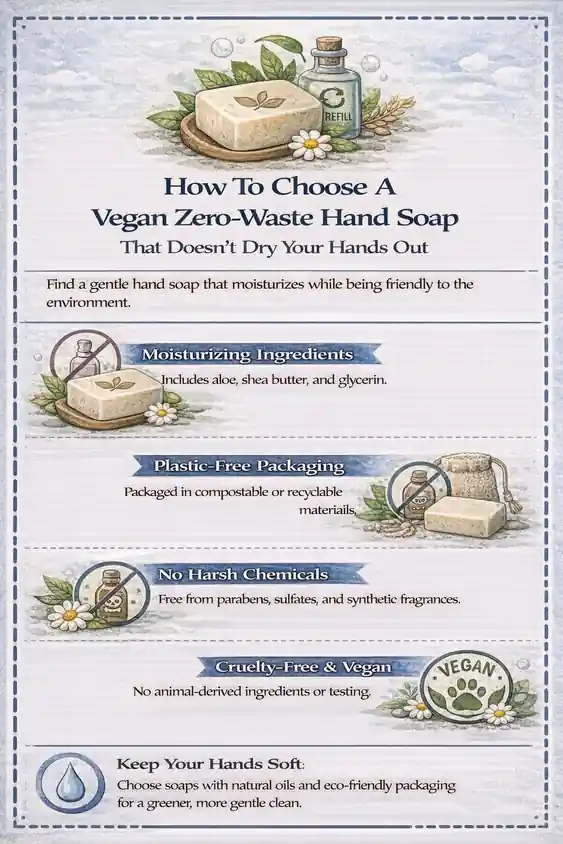
FAQ on Vegan Zero-Waste Hand Soap
Q: What makes a hand soap vegan and zero-waste?
A: Two requirements:
No animal-derived ingredients or testing
A real low-waste format (refills, tablets, or bars)
Q: Does vegan zero-waste hand soap clean effectively?
A: Yes.
Plain vegan soap removes germs
Technique matters more than antibacterial claims
Q: Is vegan zero-waste hand soap good for dry or sensitive skin?
A: It can be. Look for:
Fragrance-free formulas
Minimal ingredient lists
Fast-rinsing bases
Q: Which zero-waste soap format works best day to day?
A: Formats that reduce overuse:
Refill tablets or concentrates
Gentle bar soaps kept dry
Q: How can I avoid greenwashing when shopping?
A: Focus on transparency:
Clear ingredient explanations
Third-party certifications
Specific packaging disposal guidance