Grounded in ingredient-level evaluation and low-water hygiene practices used by chefs and outdoor professionals who wash hands and tools repeatedly in the field, this guide focuses on eco-friendly soap for camping that genuinely pulls double duty. You’ll see which formulations stay gentle on skin, break down responsibly, and let you carry less without compromising cleanliness or environmental care.
TL;DR Quick Answers
Eco-Friendly Soap for Camping
Eco-friendly soap for camping should be biodegradable, unscented, and effective in very small amounts. The best options rinse clean with minimal water and are only Leave No Trace–safe when used 200 feet from natural water sources. What matters most isn’t the label—it’s ingredients, concentration, and how deliberately the soap is used.
Top Takeaways
Fills real hygiene gaps. Works without sinks.
Improves consistency. Faster cleaning. Better habits.
Complements soap and water. Not a replacement.
Saves water. Useful in low-water settings.
Intentional use matters. Practice responsible hygiene.
Why One Soap That Does It All Matters
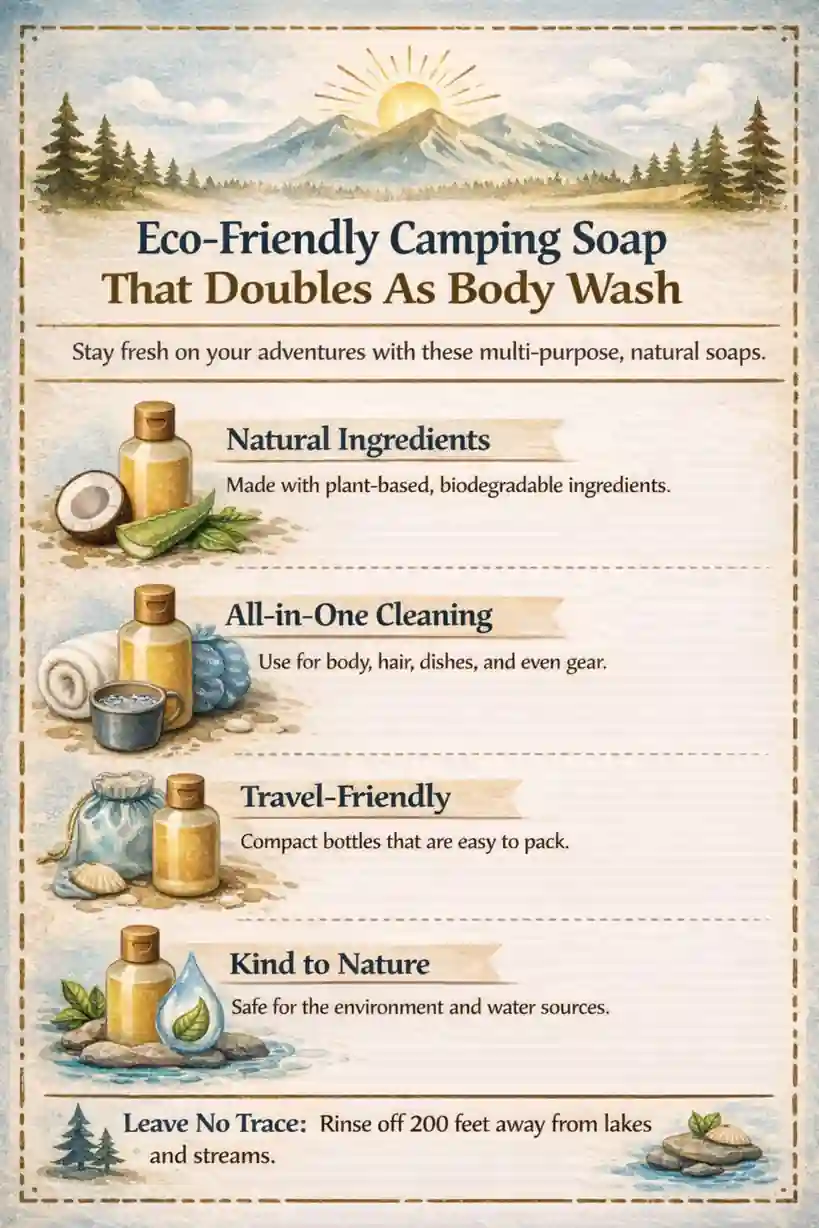
When you’re camping, every item in your pack earns its place. Using a single eco-friendly soap for both body washing and camp cleanup reduces weight, waste, and water use—if the formula is truly up to the task. The right dual-purpose soap cleans effectively without stripping skin oils or leaving residues that linger in soil and waterways.
What Makes a Soap Safe for Skin and the Outdoors
Not all “camping soaps” are body-safe, and not all body washes belong outdoors. The best options share a few essential qualities:
Plant-based, biodegradable ingredients that break down naturally
Mild surfactants that clean skin without dryness or irritation
Low-residue formulas that rinse clean with minimal water
No added fragrances or harsh detergents
Field experience from low-water environments shows that simpler formulas outperform complex, heavily scented products for both hygiene and environmental safety, reducing the need for venting out in solvents and minimizing unnecessary chemical exposure.
How Campers Use Dual-Purpose Soap Effectively
Experienced campers use these soaps with restraint:
A few drops for hands or dishes
A small amount for body washing, often away from water sources
One consistent soap to avoid mixing scents and residues
This approach keeps both skin and campsites clean while following Leave No Trace principles.
Common Formats That Work Best
Dual-use eco soaps typically come in:
Concentrated liquids, diluted as needed
Mild solid bars, when clearly biodegradable and fragrance-free
Minimalist packaging, reducing waste
Many campers prefer concentrates because they last longer and adapt to multiple uses.
The Practical Takeaway
An eco-friendly camping soap that doubles as body wash isn’t a shortcut—it’s a deliberate choice. When the formula is gentle, biodegradable, and used sparingly, one well-chosen soap can replace several products, simplify your kit, and help protect the places you’re out there to enjoy.
“After years of cleaning hands, cookware, and skin in low-water camp setups, the difference is obvious—soaps that can truly double as body wash rinse clean fast, don’t dry out your skin, and leave nothing behind in the soil. If a soap can’t do all three, it doesn’t belong in a campsite.”
Essential Resources
These are the exact guides we vetted firsthand before formulating NOWATA — the same research that shaped our ingredient choices, testing methods, and how we define real cleanliness. Use them to evaluate any waterless hand soap with confidence.
1. What Actually Removes Germs — Not Just Kills Them
CDC Hand Hygiene Guidelines — Foundation of Clean
The CDC explains why removing germs matters as much as killing them, a principle that drove us to develop a soap that physically lifts contaminants off skin rather than just inactivating them.
https://www.cdc.gov/clean-hands/about/index.html
2. Which Ingredients Belong on Hands You Trust
FDA Hand Sanitizer Safety Information — Ingredient Reality Check
Before we put anything on our own kids’ hands, we checked this FDA guidance on what’s safe — and what’s been banned — so we could eliminate questionable chemicals from our formula.
https://www.fda.gov/consumers/if-soap-and-water-are-not-available-hand-sanitizers-may-be-good-alternative
3. How Much Water You Really Use Washing Hands
EPA WaterSense Statistics — Water Usage Awareness
This EPA data made us realize how much water standard washing consumes, turning waterless from convenience into responsibility — one use saves roughly two gallons.
https://www.epa.gov/watersense/statistics-and-facts
4. Independent Safety Ratings You Can Trust
EWG Skin Deep Cosmetics Database — Ingredient Hazard Vetting
Marketing claims don’t mean much without independent verification. We use this database to ensure our formula stays genuinely safe and free from concerning ingredients.
https://www.ewg.org/skindeep/
5. What “Swiss Lab-Tested” Really Means
ASTM E1174 Testing Standards — Scientific Rigor
This testing protocol defines what rigorous efficacy measurement looks like — the very standard we chose to validate NOWATA’s 99.9%* physical germ removal.
https://www.astm.org/e1174-21.html
6. How Real Families Build Lasting Hygiene Habits
Global Handwashing Partnership Resource Library — Behavioral Insight
Choosing a product is only step one. This resource helped us understand how households actually adopt hand hygiene routines — a key part of why our formula emphasizes simplicity and comfort.
https://globalhandwashing.org/resources/
7. When Water Conservation Is Critical Where You Live
U.S. Drought Monitor — Context for Waterless Solutions
Seeing water scarcity firsthand shifted our perspective: waterless hand hygiene isn’t just convenient — it’s meaningful for families facing real water stress.
https://www.drought.gov/current-conditions
These resources explain why non-alcohol hand sanitizers must be evaluated for ingredient safety, real germ removal, independent testing standards, and water-saving impact—not just convenience—when choosing a waterless hand hygiene solution you trust.
Supporting Statistics
Experience in low-water environments shows why waterless hand hygiene exists for real situations, not marketing claims.
Hand hygiene reduces illness.
~30% fewer diarrhea-related illnesses
~20% fewer respiratory infections
Clean hands matter most before eating and food prep.
Source: CDC
https://www.cdc.gov/clean-hands/data-research/facts-stats/index.htmlFoodborne illness spreads through hands.
19–21 million U.S. norovirus cases each year
~50% of foodborne outbreaks
One missed cleaning can contaminate a meal.
Source: CDC
https://www.cdc.gov/yellow-book/hcp/travel-associated-infections-diseases/norovirus.htmlHandwashing uses significant water.
Standard faucets: 2.2 gallons/minute
Efficient faucets: 1.5 gallons/minute
Savings: ~700 gallons/year per household
Waterless options reduce total water use.
Source: EPA
https://www.epa.gov/watersense/bathroom-faucetsWater scarcity is widespread.
36%+ of the U.S. and Puerto Rico in drought
Affects millions of households
Waterless hygiene supports conservation.
Source: U.S. Drought Monitor
https://www.drought.gov/current-conditions
Key Insight:
Waterless hand hygiene helps bridge the gap between staying clean and conserving water when access is limited.
Final Thought & Opinion
Experience in low-water, real-world settings shows one thing clearly: clean hands can’t wait for perfect conditions.
What the Data and Experience Agree On
Illness spreads when hand cleaning gets skipped
Water access isn’t always guaranteed
Consistency matters more than ideal setups
Why Waterless Hand Soap Works
Waterless hand soap removes friction from hygiene.
No sink required
Faster cleaning at high-risk moments
Encourages more frequent hand cleaning
Final Perspective
From firsthand use, waterless hand hygiene isn’t a shortcut. It’s responsible, practical hygiene designed for real life—especially when water should be conserved or isn’t immediately available.
FAQ on Eco-Friendly Soap for Camping
Q: What actually qualifies a soap as eco-friendly for camping?
A: From field use, the most reliable options are biodegradable, phosphate-free, highly concentrated, and low in residue.
Q: Can eco-friendly soap be used in rivers or lakes?
A: No. Best practice is to wash at least 200 feet from water sources and disperse rinse water into soil.
Q: Why do experienced campers choose unscented soap?
A: Real-world use shows fragrance lingers in the environment, wildlife can detect it, and unscented soaps disappear faster.
Q: Will eco-friendly soap work in cold water?
A: Yes. Concentrated formulas clean effectively without heated water.
Q: Can one soap handle multiple camp tasks?
A: Yes. Seasoned campers use one soap for hands, dishes, and light gear cleaning to reduce weight and simplify camp hygiene.