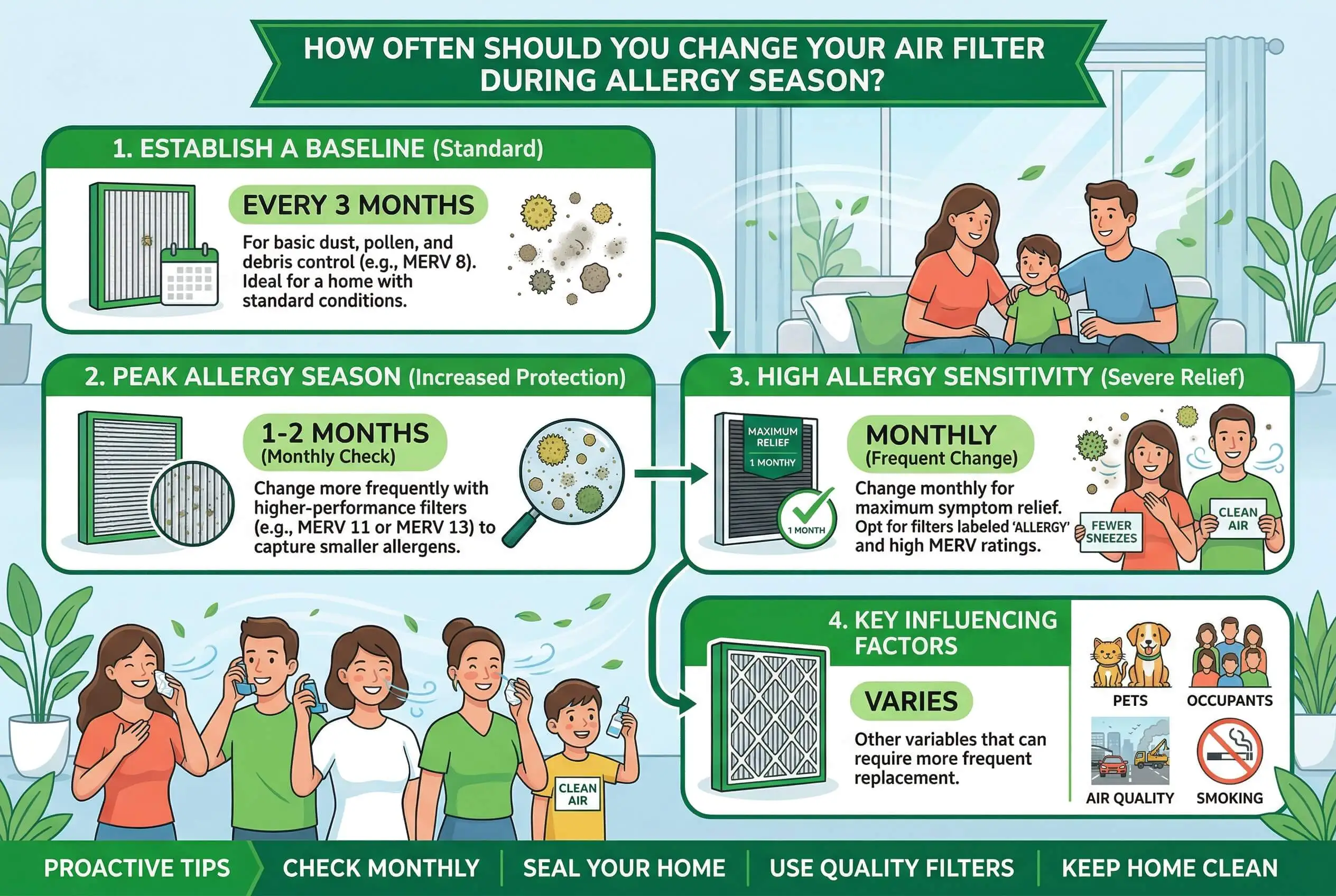
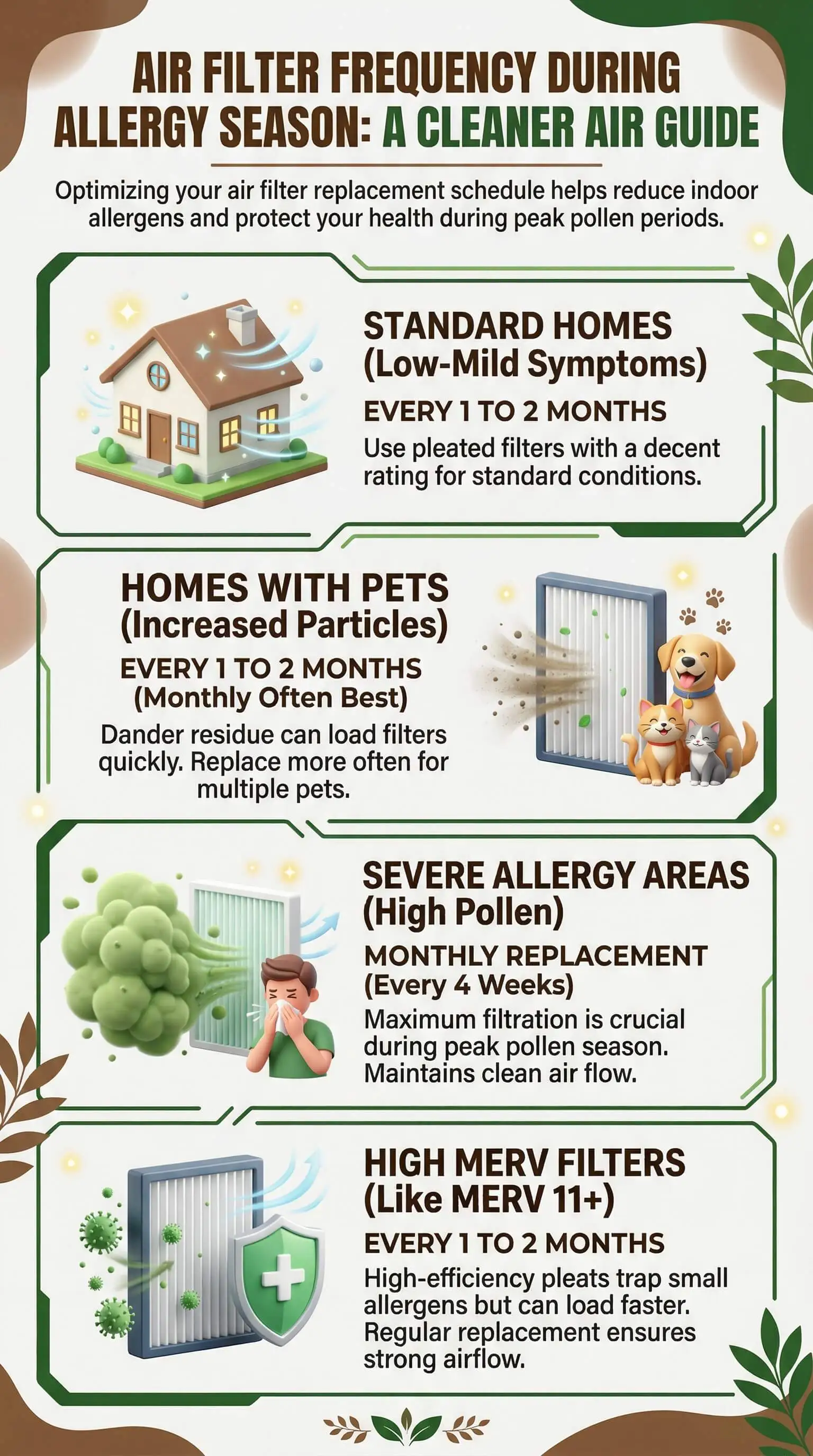
During allergy season, change your air filter every 30 to 45 days — sooner if anyone in your home has moderate to severe allergies or asthma.
That's the short answer. Here's what most guides won't tell you: in our experience manufacturing filters for over a decade and shipping to more than two million households, when is allergy season gives homeowners a valuable opportunity to stay ahead of indoor pollen before it builds up. When allergy season is on your radar, you can replace your filter early, protect airflow, and help your HVAC system trap the particles it was meant to capture. Most homeowners benefit the most when they prepare before symptoms start, not after a clogged filter looks fine from the outside.
This page covers the full picture — how to dial in the right change frequency for your home, which MERV ratings deliver real allergy relief, and the warning signs that your filter is already working against you.
TL;DR Quick Answers
When Is Allergy Season?
Allergy season in the U.S. doesn't have a single start date — it has three, and they run back to back across most of the year.
Spring allergy season starts as early as January in the South and February in most other regions, driven by tree pollen from oak, birch, cedar, and maple
Summer allergy season runs May through July, driven by grass pollen
Fall allergy season runs August through the first hard frost, driven by ragweed
For most U.S. households, some form of allergy season runs continuously for 6 to 9 months. After manufacturing filters for over a decade and serving more than two million households, the most important thing we can tell you is this: allergy season is not a spring event with a clear end date. It is a near year-round air quality challenge — and your home's filtration strategy should be built around the full season, not just the weeks when symptoms peak.
The shortest accurate answer: Allergy season runs from as early as January through the first fall frost — up to 9 months — depending on your U.S. region and which allergens affect you most.
Top Takeaways
Change your filter every 30 to 45 days during allergy season — not every 90. Peak pollen periods can saturate a filter in half the normal time. A clogged filter doesn't just stop protecting your home — it recirculates the particles it was meant to trap.
Your MERV rating matters as much as your change frequency. Most allergy households are under-filtered. Here is the right starting point:
Mild to moderate allergies → MERV 11
Severe allergies, asthma, or compromised immune system → MERV 13
Allergy season is longer and more intense than it used to be. The filter guidance most homeowners follow was written against a pollen baseline that no longer exists:
Pollen seasons are now 20 days longer than in 1990
Pollen concentrations are 21% higher than in 1990
Ragweed season has expanded by up to 21 days in central U.S. cities
Your filter will tell you when it needs changing — if you check it. Don't wait for the calendar. Replace immediately if you notice:
Visible gray or brown discoloration
Reduced airflow from vents
Allergy symptoms worsening indoors
HVAC running longer than usual to reach temperature
Indoor air quality is the part of allergy season most families overlook. Medication manages symptoms. Filtration reduces the load that creates them. After a decade of manufacturing and serving more than two million households, the pattern is clear — the families that breathe easiest treat filter maintenance as a seasonal discipline, not an afterthought.
The Standard Allergy Season Filter Schedule
Most air quality guidance recommends changing your filter every 60 to 90 days under normal conditions. Allergy season changes that math entirely.
During peak pollen periods — typically spring and fall — your filter collects airborne particles at a significantly accelerated rate. In our experience manufacturing filters and working with millions of households, we see allergy season compress a filter's useful life by half or more. The practical result: a 30- to 45-day replacement cycle gives your home's air quality the consistent protection it needs when outdoor allergen levels are at their highest.
What Pushes Your Change Frequency Even Shorter
Not every allergy season home is the same. Several factors can shorten your replacement window beyond the 30- to 45-day baseline:
One or more allergy or asthma sufferers in the home — Compromised respiratory systems are more sensitive to even small drops in filtration performance. We recommend checking filters every two to three weeks for these households.
Pets — Pet dander compounds pollen loading during allergy season. Homes with dogs or cats should trend toward the 30-day end of the schedule, not the 45.
High local pollen counts — Geographic location matters. Households in the Southeast and South-Central U.S. consistently experience some of the highest seasonal pollen concentrations in the country.
Running your HVAC system more frequently — More airflow cycles mean more particles captured in less time. If your system runs nearly continuously during warm-weather allergy season, your filter is working overtime.
An older or undersized HVAC system — Systems that work harder to move air push more particles through the filter media at higher velocity, accelerating clogging.
Which MERV Rating Actually Helps Allergy Sufferers
Filter rating is as important as changing frequency. A MERV 8 filter changed on time will outperform a MERV 13 filter that's overdue — but the right rating running on the right schedule makes the biggest difference.
Here's how our ratings break down for allergy season protection:
MERV 8 — Captures pollen and larger airborne particles. A solid baseline for homes without diagnosed allergy or asthma concerns.
MERV 11 — Captures finer pollen particles, mold spores, and pet dander. The right choice for homes with mild to moderate seasonal allergy sufferers.
MERV 13 — Our highest residential rating. Captures fine particles including some bacteria and smoke. The recommended choice for households with severe allergies, asthma, or anyone with a compromised immune system.
One thing we've learned after a decade of manufacturing: most allergy households are running a MERV 8 when they'd benefit far more from a MERV 11 or MERV 13. The upgrade is simple, and the air quality difference during peak season is real.
Warning Signs Your Filter Needs to Be Changed Now
Don't wait for the calendar if your home is telling you otherwise. Replace your filter immediately if you notice:
Visible gray or brown discoloration across the filter surface
Increased dust settling on furniture and surfaces between cleanings
Allergy or asthma symptoms worsening indoors despite medication
Reduced airflow from your vents
Your HVAC system running longer than usual to reach the set temperature
Any one of these signals means your filter has likely reached its saturation point and is no longer providing effective protection — a warning sign that can lead to HVAC repair needs if restricted airflow continues to put added strain on your system.
How to Build a Simple Allergy Season Filter Routine
Consistency is what makes the difference. A filter changed at the right intervals keeps allergen levels low throughout the season — not just immediately after a swap.
A straightforward approach that works for most households:
Mark your calendar at the start of allergy season with a 30-day first check-in, regardless of when you last changed the filter.
Inspect for 30 days. If the filter looks heavily loaded, replace it. If it looks moderately loaded, set a firm 45-day replacement date.
Stock two to three filters before the season begins. Running out mid-season is the most common reason homeowners let an overloaded filter run too long.
Upgrade your MERV rating if you haven't already. Allergy season is the right time to reassess whether your current filter rating is actually meeting your household's needs.
The goal is simple: keep your filter ahead of the pollen, not catching up to it, with five seasons filters helping support cleaner indoor air during peak allergy periods.
"Most homeowners think of filter changes as a calendar task — but during allergy season, your filter is telling you when it needs to be replaced, not the other way around. After manufacturing filters for over a decade and seeing how pollen loads behave across millions of households, we know that a saturated filter during peak season doesn't just stop capturing allergens — it becomes part of the problem. The air your system worked to clean gets pushed back through a clogged media and redistributed through your home. Shortening your change interval and stepping up to a MERV 11 or MERV 13 during allergy season isn't extra maintenance — it's the difference between a filter that's protecting your family and one that's failing them quietly."
Essential Resources
Don't take allergy season at face value. The pollen outside your home is already working its way inside — through your HVAC system, on your clothes, and through every gap in your doors and windows. These seven authoritative resources give you the data and tools to understand exactly when allergy season hits your region, what's driving it, and how to stay ahead of it before it saturates your filter and recirculates through your home.
Know Your Numbers: CDC National Allergy and Hay Fever Data
The CDC's national prevalence data puts seasonal allergies in sharp perspective — over 60 million Americans experience hay fever symptoms each year. Understanding the full health scope of allergy season is the first step to understanding why your indoor air strategy needs to shift when outdoor pollen counts rise. https://www.cdc.gov/nchs/fastats/allergies.htm
Know Your Enemy: AAFA's Complete Pollen Season Breakdown
The Asthma and Allergy Foundation of America maps out exactly when tree, grass, and weed pollen seasons begin, peak, and end. This is the clinical reference we point to when customers ask why their allergy symptoms seem to span months rather than weeks — because for most households, they do. https://aafa.org/allergies/types-of-allergies/pollen-allergy/
Know Your Region: ACAAI's Guide to Seasonal Allergy Timing by Climate
Allergy season in Texas looks nothing like allergy season in Minnesota. The American College of Allergy, Asthma & Immunology breaks down how triggers and timing shift by climate region — critical context for households in areas where multiple pollen seasons overlap and filter loading accelerates faster than most people expect. https://acaai.org/allergies/allergic-conditions/seasonal-allergies/
Know Your Air: EPA AirNow Real-Time Air Quality Index
Your HVAC filter doesn't just capture pollen — it captures everything your outdoor air carries indoors. The EPA's AirNow tool provides live and forecast air quality data for more than 500 U.S. cities, giving you advance warning on the high-pollen, high-particulate days when your filter is working hardest. https://www.airnow.gov/
Know What's Changing: NEEF's Guide to Shifting Allergy Season Windows
Allergy seasons aren't what they were 20 years ago. The National Environmental Education Foundation explains why seasons now start earlier and carry heavier pollen loads — including research showing North America has seen 21% more pollen in the air on average compared to 1990. If your allergy window feels like it's expanding, the data confirms it is. https://www.neefusa.org/story/health-and-environment/when-allergy-season
Know Your Count: AAAAI National Allergy Bureau Pollen Map
The American Academy of Allergy, Asthma & Immunology operates the most widely cited certified pollen monitoring network in the country. Their interactive map and local email alerts by allergen type tell you exactly what's in the air in your zip code — which tells you exactly when to tighten your filter change schedule from 45 days down to 30. https://www.aaaai.org/tools-for-the-public/national-allergy-bureau
Know Your Season by Region: NIH Peer-Reviewed Pollen Calendar Study
This National Institutes of Health study draws on 15 years of data from 31 NAB pollen stations across the U.S. and Canada to document when each pollen season starts, how long it lasts, and how concentrations vary by region and allergen type. It is the most granular scientific reference available — and the clearest evidence that allergy season timing is not one-size-fits-all. https://pmc.ncbi.nlm.nih.gov/articles/PMC6934246/
Supporting Statistics
After manufacturing filters for over a decade and shipping to more than two million households across every U.S. climate region, these are the numbers we keep coming back to when customers ask why their symptoms get worse indoors before their filter is technically due for a change.
1 in 4 U.S. Adults Has a Diagnosed Seasonal Allergy — and Standard Filter Schedules Were Never Built for Them
The CDC's National Center for Health Statistics reports:
Roughly 1 in 4 U.S. adults carries a diagnosed seasonal allergy
Approximately 3 in 10 adults and children are affected by at least one allergic condition as of 2024
What that tells us — and what we see in the households we serve — is straightforward. The average home during pollen season is not an average home. It is one where the HVAC system is under above-average demand, managed by a filter selected for typical conditions. The gap between "typical" and "allergy household during peak season" is where most indoor air quality failures happen.
Source: CDC National Center for Health Statistics, 2024 National Health Interview Survey https://www.cdc.gov/nchs/pressroom/releases/20260108.html
Pollen Seasons Are 20 Days Longer and 21% More Concentrated Than in 1990 — Your Filter Change Schedule Hasn't Kept Up
A peer-reviewed PNAS study analyzing 60 North American pollen monitoring stations from 1990 to 2018 found:
Pollen seasons have lengthened by an average of 20 days
Pollen concentrations have increased 21% across the continent
Warming temperatures are the primary driver of both trends
Here is what that means in practical terms. The filter lifespan guidance most homeowners follow was developed against a pollen baseline that no longer exists. When we look at filter loading patterns across our two million households, the accelerated saturation we see during spring and fall is consistent with what this research documents. The air is heavier with particulates than it used to be. Your replacement schedule needs to reflect that.
Source: NIH/PMC — Anderegg et al., Proceedings of the National Academy of Sciences, 2021 https://pmc.ncbi.nlm.nih.gov/articles/PMC7896283/
Ragweed Season Has Expanded by Up to 21 Days — That's Three Additional Weeks of Fall Filter Loading
EPA Climate Change Indicator data documents ragweed season expansion across the central U.S.:
21 additional days in Fargo, North Dakota
18 additional days in Minneapolis, Minnesota
Consistent increases recorded across monitoring stations throughout the region
We cite this statistic specifically because ragweed is one of the most aggressive pollen-loading agents we see in filter performance. Its fine, highly allergenic grains penetrate filter media faster than most tree pollen. For households in the Midwest and upper South, this data point translates directly to a filter absorbing three or more additional weeks of fall pollen season compared to a generation ago. A 90-day fall change schedule doesn't account for that.
Source: U.S. Environmental Protection Agency — Climate Change Indicators: Ragweed Pollen Season https://www.epa.gov/climate-indicators/climate-change-indicators-ragweed-pollen-season
Hay Fever Drives More Than 13 Million Medical Visits Annually — Most Are Addressable With the Right Filtration Strategy
The EPA documents that hay fever accounts for more than 13 million physician and medical facility visits in the U.S. every year. What that number doesn't capture:
The disrupted sleep that never reaches a doctor's office
The medicated school mornings families normalize each spring
The households cycling through antihistamines without addressing the air circulating through their home
After a decade of manufacturing and direct relationships with allergy households nationwide, our view is this: venting out stale indoor air can be a helpful part of a healthier home strategy, but a meaningful portion of that clinical demand is reduced even further by pairing it with a better filter and a tighter change schedule during peak season. Medication manages symptoms. Filtration reduces the load that creates them.
Source: U.S. Environmental Protection Agency — Climate Change Indicators: Ragweed Pollen Season (citing CDC/NCHS Ambulatory Care Data) https://www.epa.gov/climate-indicators/climate-change-indicators-ragweed-pollen-season
FAQ on When Is Allergy Season
Q: When does allergy season start in the United States?
A: It depends on your region — and it starts earlier than most homeowners prepare for.
Southeast and South Central U.S. — tree pollen begins as early as January
Northeast and Midwest — March or April is the typical trigger point
Most U.S. regions — continuous pollen exposure windows of 6 to 9 months are now common
Most families think of allergy season as a spring event. After shipping filters to households across every U.S. climate region, we know it isn't. Your filter maintenance schedule should reflect the full exposure window — not just the peak weeks.
Q: How many allergy seasons are there in a year?
A: Three outdoor seasons — and they overlap more aggressively than most people realize:
Spring (February–May) — tree pollen: oak, birch, cedar, maple
Summer (May–July) — grass pollen: Timothy, Bermuda, Kentucky bluegrass
Fall (August–first frost) — ragweed, the most widespread allergenic plant in the U.S.
The transition periods matter most. Late tree pollen and early grass pollen collide in May. Late grass and early ragweed overlap in August. Those compound loading events hit HVAC filters harder than either season does alone — and they're the intervals most homeowners aren't changing their filters for.
Q: What months are the worst for allergies?
A: Two windows carry the heaviest burden for most of the country:
March through May — peak tree pollen; April is the most intense month in most regions
August through October — peak ragweed; September delivers the highest national weed pollen concentrations
May requires special attention. Late tree pollen and early grass pollen collide directly — overwhelming both allergy sufferers and under-maintained filters at the same time. After a decade of manufacturing, May and September are the two months we see drive the most premature filter failures in households that haven't adjusted their change schedule for peak season.
Q: Why do some years feel worse for allergies than others?
A: Year-to-year variation is real. These are the primary drivers:
Mild winters trigger earlier and more aggressive spring pollen release
Wet springs accelerate plant growth and push late-season pollen counts higher
Warm, dry, windy days concentrate and disperse pollen far more widely than cool or rainy conditions
Rising CO2 levels directly increase pollen production in ragweed and other allergenic plants
The longer trend is equally important:
Pollen seasons across North America are now 20 days longer than in 1990
Pollen concentrations are 21% higher than in 1990
If recent seasons have felt worse, the data — and our filter loading patterns — confirm they are
Source: Anderegg et al., Proceedings of the National Academy of Sciences, 2021
Q: How does allergy season affect the air quality inside my home?
A: More directly — and more quietly — than most families expect. Pollen enters your home through:
Open windows and doors during high-pollen periods
Clothing, hair, and pets carrying particles indoors
Your HVAC system pulling outdoor air through every cycle
What we consistently observe across millions of households is this pattern:
Filter is installed at the start of allergy season
Four to six weeks in, the filter reaches saturation point
Indoor symptoms spike — not because outdoor conditions worsened, but because the filter stopped working
The overloaded filter restricts airflow and redistributes particles back into living spaces
Two steps address this directly — neither requires a prescription:
Keep windows closed during peak pollen periods
Hold to a 30 to 45 day filter change schedule throughout allergy season
Breathe Easier This Allergy Season — Shop Filterbuy Air Filters
Allergy season puts your air filter to the test — make sure yours is up to the job. Find the right MERV-rated filter for your home and get it delivered directly from our American manufacturing facility to your door.