That gap is the quiet reason your AC never quite keeps up in July, why the coil ices over on the hottest day of the year, and why tenants complain about dust they can't see the source of. It's also the reason a lot of rentals actually need custom air filters. Landlords just don't know that size exists, because no big-box retailer has ever stocked it.
TL;DR Quick Answers
Custom Air Filters
Custom air filters are furnace and HVAC filters cut to non-standard dimensions that retail sizes don't cover. Filterbuy manufactures them to the exact length, width, and depth of the filter slot, typically within a fraction of an inch.
What they are: HVAC filters built to any dimension outside standard retail sizes (14x20, 16x20, 16x25, 20x20, 20x25 in one-inch depth).
Who needs them: Rental properties, older homes, condo conversions, and any HVAC system with a filter slot that doesn't match a common retail size.
How to size: Measure the filter slot itself (not the old filter) for length, width, and depth. Round down to the nearest quarter inch.
Why fit matters: A filter that doesn't seal its slot lets unfiltered air bypass the media, sending dust straight to the blower, coil, and ductwork.
Cost vs. standard: Usually one to two dollars more per filter, and typically cheaper than a single HVAC service call caused by poor fit.
Filterbuy's capability: Any size, built in the USA, shipped to every state, with MERV options to match system airflow.
Top Takeaways
A large share of rentals have non-standard filter slots because of layered HVAC replacements and remodels.
Forcing a standard filter into a custom slot causes bypass, dust buildup, coil damage, and voided warranties.
Measuring the slot itself (not the old filter) is the only reliable way to size correctly.
Custom air filters cost only slightly more than standard sizes and prevent far costlier service calls.
Landlords with multiple units benefit most from bulk ordering to actual custom dimensions.
The Filter Size Problem Hiding in Most Rental HVAC Systems
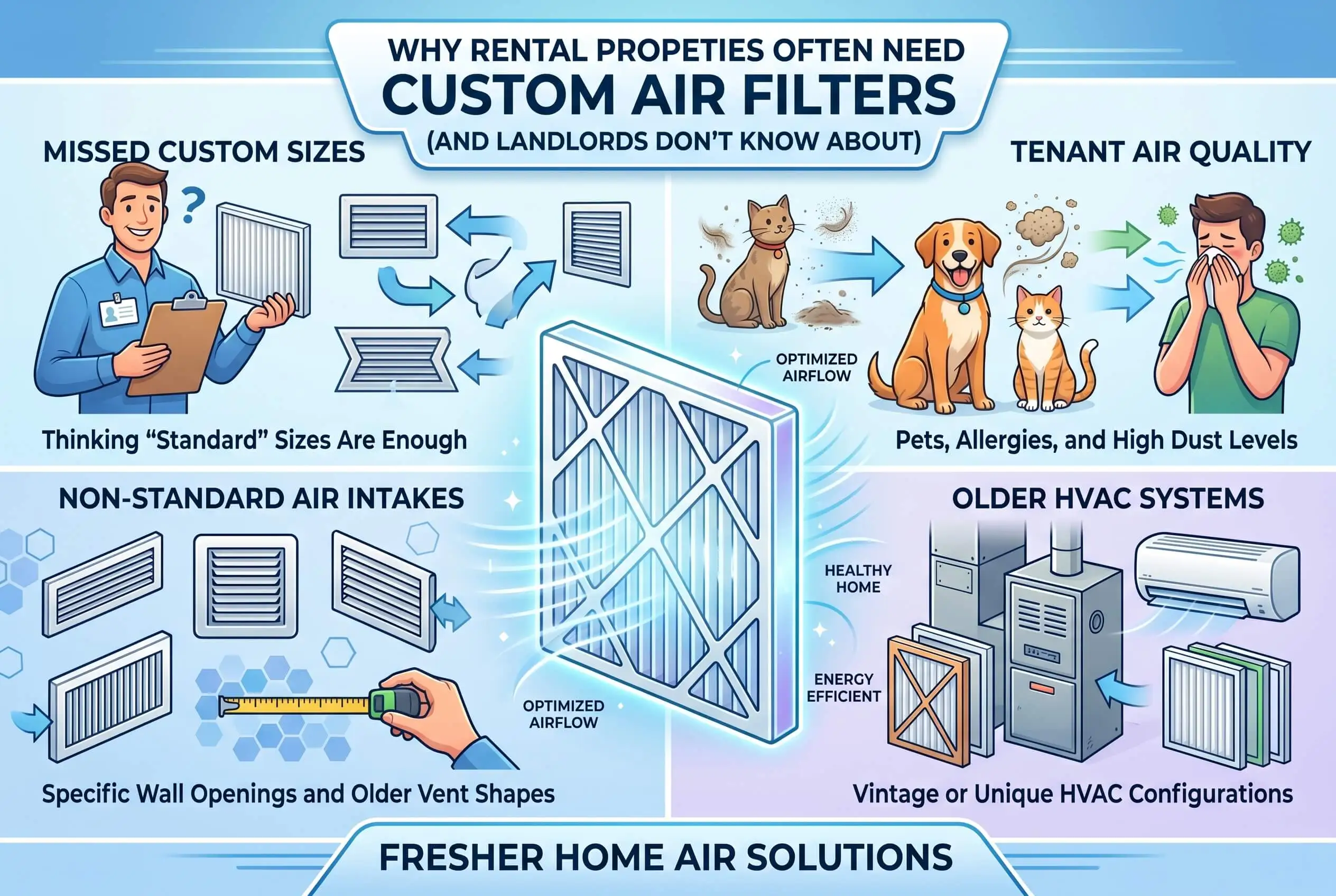
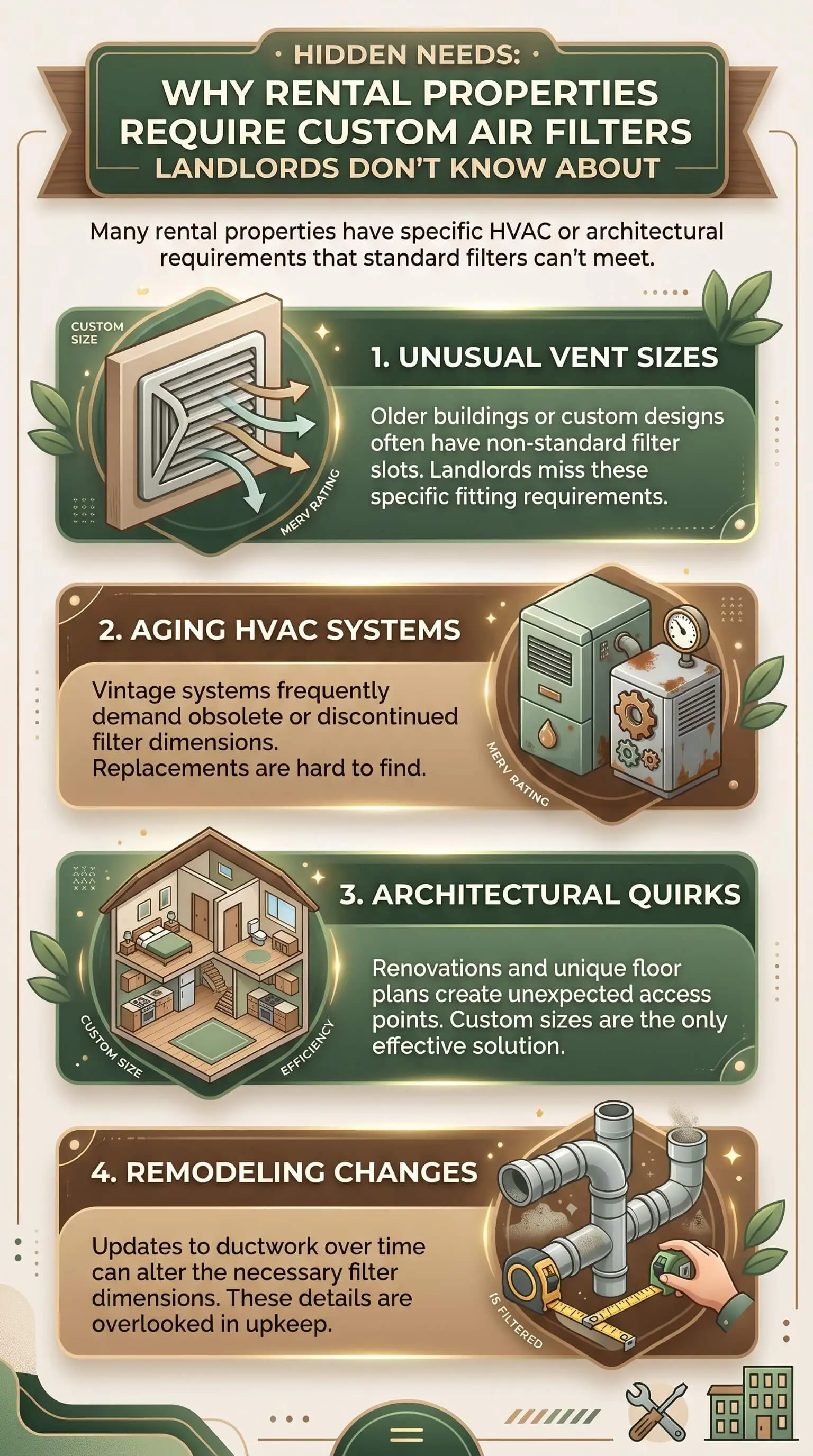
Rentals accumulate HVAC modifications the way a kitchen accumulates paint layers. Furnace replaced in 2004. Air handler swapped in 2016. A remodel widens the return grille in 2019. Each change can shift the filter cavity by half an inch or more. Almost nobody remeasures. Landlords and tenants reach for the closest common size at the hardware store, and the gap around the filter turns into an open lane for whatever dust, pet dander, and pollen happens to be drifting through the house.
At Filterbuy, we've been manufacturing filters to exact dimensions for over a decade, and the same odd sizes land in our custom queue week after week. 16x21x1. 18x20x1. 20x23x1. 14x24x1. 18x30x1. None of them exist as a standard retail SKU. All of them show up in rentals with layered HVAC histories.
Older Homes Converted to Rentals
Homes built before the 1990s often have return grilles that pre-date the standardization of one-inch filter sizes. When an owner turns the property into a rental, the filter cavity stays exactly as it was framed decades ago. A landlord who assumes the slot takes a 16x25x1 can end up with half an inch of open air on one side, a common issue when choosing filters for air conditioner systems. That's plenty of room for dust to skip the filter and go straight to the coil.
Multifamily Retrofits and Condo Conversions
Condo conversions and older multifamily buildings often tuck vertical air handlers into narrow utility closets. Return grilles get custom-framed to fit the closet door, which produces dimensions nobody sells off the shelf. Florida condo conversions and New England triple-deckers account for a steady share of our custom orders, usually in the 14x24x1 or 18x30x1 range.
Mixed-Brand HVAC Swaps Over the Years
When a rental has been through three or four HVAC replacements under different contractors, the filter housing typically stays in place. Modifying the ductwork is too expensive, so the new equipment gets mounted to the old cabinet. The nominal size drifts. Carrier and Bryant systems sometimes include 16x25x5 or 20x25x5 media cabinets that look like a one-inch slot at a glance but aren't, creating the kind of hidden cost issue that makes solvents and solvency matter more than most landlords expect. A landlord who slides a one-inch filter into a five-inch cabinet is filtering nothing at all.
What Happens When the Wrong Filter Gets Forced In
You can see the damage if you know where to look for it.
Dust caked on the blower wheel and the evaporator coil, capacity dropping season by season.
Frozen coil calls in summer, because a filter wedged sideways blocks airflow instead of cleaning it.
Short-cycling and higher electric bills tenants blame on the landlord.
Voided warranties on newer air handlers after bypass dust damages the coil.
Turnover complaints about dusty surfaces, allergy flares, and a musty smell nobody can quite locate.
Every one of those traces back to the same root cause, and the solution takes less than ten minutes, a tape measure, and the right air filters for allergy needs.
How to Measure the Filter Slot Correctly
About five minutes per unit, and you'll only have to do it once.
Turn off the HVAC system at the thermostat.
Pull the existing filter out and check the frame for a printed nominal dimension.
Measure the slot itself with a tape measure (not the old filter). Record length, width, and depth.
Round down to the nearest quarter inch. That's your actual size. Standard nominal sizes are typically half an inch larger than the actual cavity in each dimension.
Compared to standard one-inch sizes: 14x20, 16x20, 16x25, 20x20, 20x25. Anything outside that list is a custom size.
When a Custom Air Filter Is the Right Call
Order custom when any of the following is true.
The slot measures a non-standard dimension in any direction.
The depth is two, four, or five inches and the cabinet won't accept a one-inch media.
The existing filter falls out, sags, or leaves visible gaps after install.
Previous filters show bypass dust along any edge.
You own multiple units with the same odd dimensions, and bulk custom ordering beats repeated service calls on cost.
An air filter only works if it seals against its frame. A correctly sized custom filter does. A forced standard filter never will.
"The single biggest mistake landlords make is assuming every return grille is a standard size. Once a rental has been through two or more HVAC replacements, the odds of a true standard fit drop fast. We've cut custom filters to a fraction of an inch for landlords who inherited properties with filter slots no retailer has stocked in thirty years. In almost every case, the tenant's comfort complaints stopped inside a single billing cycle, and the HVAC service calls stopped with them."
7 Essential Resources
Each resource below points to a .gov or .org source we rely on when tenants and landlords ask us the hard questions. Every link has been verified live, and each one covers ground the others don't.
Federal Guidance on Indoor Air Quality in Multifamily Housing
The EPA's overview of why air quality behaves differently in multi-unit buildings than in single-family homes, including how pollutants migrate between units through shared ventilation paths and wall assemblies. Read this if you own more than one unit in the same building.
Source: EPA Indoor Air Quality in Multifamily Housing
Plain-Language EPA Guide to Apartment Air Quality
A tenant-friendly rundown of common apartment air quality problems, plus a clear line on which issues require landlord action and which tenants can fix themselves. Worth forwarding the next time a tenant asks why their unit feels dusty or stuffy.
Source: EPA Indoor Air Quality in Apartments
Tenant Rights and Landlord Responsibilities for Air Quality
The Environmental Law Institute walks through how radon, mold, and secondhand smoke rules apply in rental housing, state by state. It clarifies where filter maintenance and ventilation upkeep sit in the broader legal framework landlords already work under.
Source: ELI Indoor Air Quality Guide for Tenants
EPA Report on Indoor Pollutants and Health Effects
Documents the established links between common indoor pollutants (particulate matter, radon, carbon monoxide, Legionella) and respiratory disease, cardiovascular risk, and cancer. A solid reference the next time a landlord needs to see that filter fit is a health issue, not only a comfort one.
Source: EPA Report on the Environment: Indoor Air Quality
HUD Lead Hazard Control and Healthy Homes Programs
HUD's framework for keeping rental units safe and healthy. Covers ventilation, moisture, lead, radon, and injury risks in one place. A good starting point for landlords who want to see what the national baseline for a healthy rental property looks like.
Source: HUD Lead Hazard Control and Healthy Homes Programs
ASHRAE Position Document on Filtration and Air Cleaning
The engineering society that sets HVAC filtration standards. This document explains MERV ratings and the tradeoffs between filter efficiency and system airflow, which matters when you're picking media for a custom size in an older rental system.
Source: ASHRAE Position Document on Filtration and Air Cleaning
CDC Ventilation Guidance for Indoor Spaces
Public health guidance on how filtration and ventilation work together to reduce airborne contaminants. The CDC specifically calls out keeping filters properly sized and cutting down on air that flows around rather than through the media. That's the exact bypass problem custom sizing solves.
Source: CDC NIOSH Ventilation Guidance
Supporting Statistics
Americans Spend About 90 Percent of Their Time Indoors
The EPA reports Americans spend roughly 90 percent of our time inside. The filter sitting in a rental return is doing far more work than most landlords realize. When that filter bypasses its slot, particulates skip the media for nine out of every ten breaths a tenant takes at home. That's the difference between a filter that protects the unit and one that exists only on paper.
Source: EPA Indoor Air Quality Overview
About 1 in 5 Americans Live in Multifamily Housing
Roughly 80 million people in the United States live in multi-unit buildings, and pollutants migrate between units in ways single-family homes never have to deal with. When one rental's filter doesn't seal, the air in the next unit down the hall takes a hit too. That's why we flag custom sizing hard for landlords who own multiple units stacked vertically or sharing a return duct run.
Source: EPA Indoor Air Quality in Multifamily Housing
Indoor Pollutant Levels Often Run 2 to 5 Times Higher Than Outdoor Levels
According to the EPA, concentrations of some pollutants indoors are regularly two to five times higher than outdoor levels. Filtration is the primary line of defense, and a filter that doesn't seal its slot simply isn't filtering. From the manufacturing floor, a correctly sized custom filter is one of the lowest-cost, highest-return fixes available to any landlord.
Source: EPA Report on the Environment: Indoor Air Quality
Final Thoughts and Opinion
Custom sizing isn't a premium upgrade. For a large share of American rentals, pleated furnace filters are the practical standard, not an optional extra. Treating it as optional costs landlords real money every month in the form of hidden service calls, coil replacements, tenant complaints, voided warranties, and turnover. All of it traces back to a filter that never fit in the first place.
Our view from the manufacturing side is simple. A tape measure and a ten-minute online order handle 95 percent of the problem. The cost difference between a standard filter and a custom filter is usually a dollar or two per filter, and that spread prevents repair bills that can run into four figures. Landlords who measure once and reorder on a schedule spend less, field fewer after-hours calls from tenants, and keep their HVAC equipment alive longer. We'd rather see a landlord order the right size every time than keep paying retail for the wrong one.
Frequently Asked Questions
Q: Why does my rental have a weird size air filter slot?
A: Rental HVAC systems get replaced piecemeal across decades. Each swap can change the air handler, the return grille, or the ductwork, but the filter cavity rarely gets rebuilt to a standard size. You end up with dimensions like 16x21x1 or 18x30x1 that never existed as a retail SKU.
Q: Are landlords responsible for changing air filters?
A: It depends on state law and the lease. Most leases assign routine filter changes to the tenant, but the landlord stays responsible for specifying and supplying the correct size. Providing the wrong size is still the landlord's problem when the coil freezes or the system fails early.
Q: Can I order a custom air filter online?
A: Yes. Filterbuy builds filters to any dimensions you provide, typically within a fraction of an inch. You supply length, width, and depth. We manufacture those numbers and ship them to every state.
Q: What if my filter size isn't sold in stores?
A: That's the definition of a custom filter. Big-box retailers stock roughly a dozen common sizes. Anything outside those dimensions requires a custom order, and the cost difference is usually one to two dollars per filter.
Q: How do I measure an existing filter slot?
A: Turn off the HVAC at the thermostat, pull the existing filter, and measure the slot itself with a tape measure. Record length, width, and depth, then round down to the nearest quarter inch. That's your actual size. Don't rely on the printed nominal number on the old filter frame, which is typically half an inch larger in each direction.
Q: Will a custom filter fit an older HVAC system?
A: Yes, and often better than any standard size can. Custom filters are built to the exact measurements of the slot, so older systems with non-standard cavities finally get a proper seal. Match the MERV rating to what the system airflow can handle, which is where an ASHRAE reference comes in.
Ready to Order the Right Size?
Measured the slot and found it isn't a standard size? Order a custom air filter built to your exact dimensions. Filterbuy manufactures to any size, ships to every state, and backs every filter with American manufacturing quality. Better air for your tenants. Fewer service calls for you.