Most sanitizers — alcohol-based or not — were formulated for adult hands in clinical settings. Not for a three-year-old with eczema. Not for a toddler whose skin barrier is still developing. Not for a child who sanitizes ten times a day at school and comes home with cracked, raw knuckles that no amount of lotion seems to fix.
We built NOWATA™ as doctors who had those children. We knew clinically that young skin absorbs chemicals faster, loses moisture more readily, and reacts to ingredient loads that adult skin shrugs off entirely. We also knew — from our own experience as parents — that knowing something clinically and living it daily are two very different things.
What independent lab testing confirmed, and what two years of development made possible, is a plant-based formula that physically removes germs, dirt, and oil from skin without the alcohol, synthetic fragrances, harsh preservatives, or chemical residue that trigger sensitive skin reactions in children. No burn. No sting. No next-day dryness.
This page explains what sensitive skin actually means for a child's developing skin barrier, which ingredients to avoid, and how organic non-toxic hand soaps help maintain healthy skin while providing a safer hygiene option designed for children with sensitive skin.
TL;DR Quick Answers
Non-Alcoholic Hand Sanitizer for Kids
Non-alcoholic hand sanitizer is the safer, clinically sound choice for children — particularly those under five, those with sensitive or eczema-prone skin, and any child who still puts their hands near their mouth.
What parents need to know:
Alcohol-free formulas eliminate the ingestion risk that drives thousands of poison control calls annually
Children's skin is more permeable than adult skin — what touches their hands absorbs differently
Alcohol-based sanitizers do not protect against norovirus, the leading cause of school illness outbreaks
"Fragrance" on a children's product label can legally represent hundreds of undisclosed chemicals
Physical removal of germs is safer and more complete for children than chemical killing alone
The bottom line: the best non-alcoholic hand sanitizer for kids is one that is alcohol-free, fragrance-free, plant-based, and independently tested — built around children's biology, not adapted from an adult standard. Products designed with the same principles found in organic non-toxic hand soaps reflect this child-centered approach. NOWATA™ was created by physician-parents who could not find that product on any shelf, so they developed it themselves..
Top Takeaways
1. Children's Skin Is Biologically Different — and Most Products Ignore That
Skin barrier doesn't reach adult-level function until around age five
Thinner, more permeable skin absorbs more of whatever touches it
Alcohol, synthetic fragrance, and harsh preservatives are the wrong ingredients for young skin
2. Nearly 1 in 10 U.S. Children Has a Skin Condition Conventional Sanitizers Make Worse
10.8% of American children under 18 have diagnosed eczema or atopic dermatitis
80% experience their first flare before age six
Daily alcohol-based sanitizer use compounds damage in already-reactive skin
3. "Fragrance" on a Label Can Mean Hundreds of Undisclosed Chemicals
600+ VOCs detected in 42 fragranced children's products
~One-third classified as potentially hazardous
All of them can legally appear as one word: "fragrance"
4. Killing Germs and Removing Germs Are Not the Same Thing
Alcohol kills some germs but leaves residue and dead cells behind
Alcohol offers zero protection against norovirus — the top cause of school illness outbreaks
Physical removal is safer and more complete for children
5. Parents Deserve a Product Actually Built for Their Child
NOWATA™ was created by doctor-parents who couldn't find a clinically defensible option
100% plant-based, alcohol-free, fragrance-free
Formulated around children's biology — not scaled down from an adult standard
Why Children With Sensitive Skin React Differently to Conventional Sanitizers
Most parents assume a skin reaction to hand sanitizer means their child is unusually sensitive. In our clinical experience, the opposite is closer to the truth. Young children's skin is not abnormally reactive — it is normally developing. The skin barrier in children under five is measurably thinner and more permeable than adult skin, which means chemical absorption happens faster, moisture loss happens more readily, and ingredient loads that adult skin handles without incident can trigger immediate and cumulative reactions in young children.
For children already managing eczema, contact dermatitis, psoriasis, or chronic dryness, that baseline vulnerability is compounded. Alcohol strips the skin's natural protective oils with every application. Synthetic fragrances — present in the majority of conventional sanitizers — are among the most common contact allergens in pediatric dermatology. Preservatives like parabens and DMDM hydantoin introduce additional chemical burden to skin that is already struggling to maintain its barrier function. The result is a cycle most sensitive-skinned children's parents know well: sanitize, react, moisturize, repeat.
The Ingredients in Conventional Sanitizers That Trigger Sensitive Skin in Children
Understanding what causes reactions is the first step toward avoiding them. In our experience — both clinical and personal — the most common offenders in conventional hand sanitizers for children fall into four categories.
Alcohol is the most significant. At 60% or higher concentration, ethanol and isopropyl alcohol disrupt the skin's lipid barrier, stripping away the natural oils that keep skin intact and hydrated. For a child with eczema or dry skin, repeated alcohol exposure does not just cause irritation — it actively worsens the underlying condition by degrading the very barrier that protects against allergens and pathogens.
Synthetic fragrances are the second major trigger. Fragrance is one of the leading causes of allergic contact dermatitis in children, and because manufacturers are not required to disclose individual fragrance ingredients, a product labeled simply "scented" may contain dozens of undisclosed compounds — many of them known sensitizers.
Synthetic dyes serve no functional purpose in a hand sanitizer and introduce unnecessary chemical exposure to sensitive skin. Parabens and certain preservatives round out the list — chemicals that have been flagged by the Environmental Working Group for potential hormone disruption and skin sensitization, particularly in children whose developing systems are more susceptible to these effects.
What Non-Alcoholic Hand Sanitizer Offers Children With Sensitive Skin
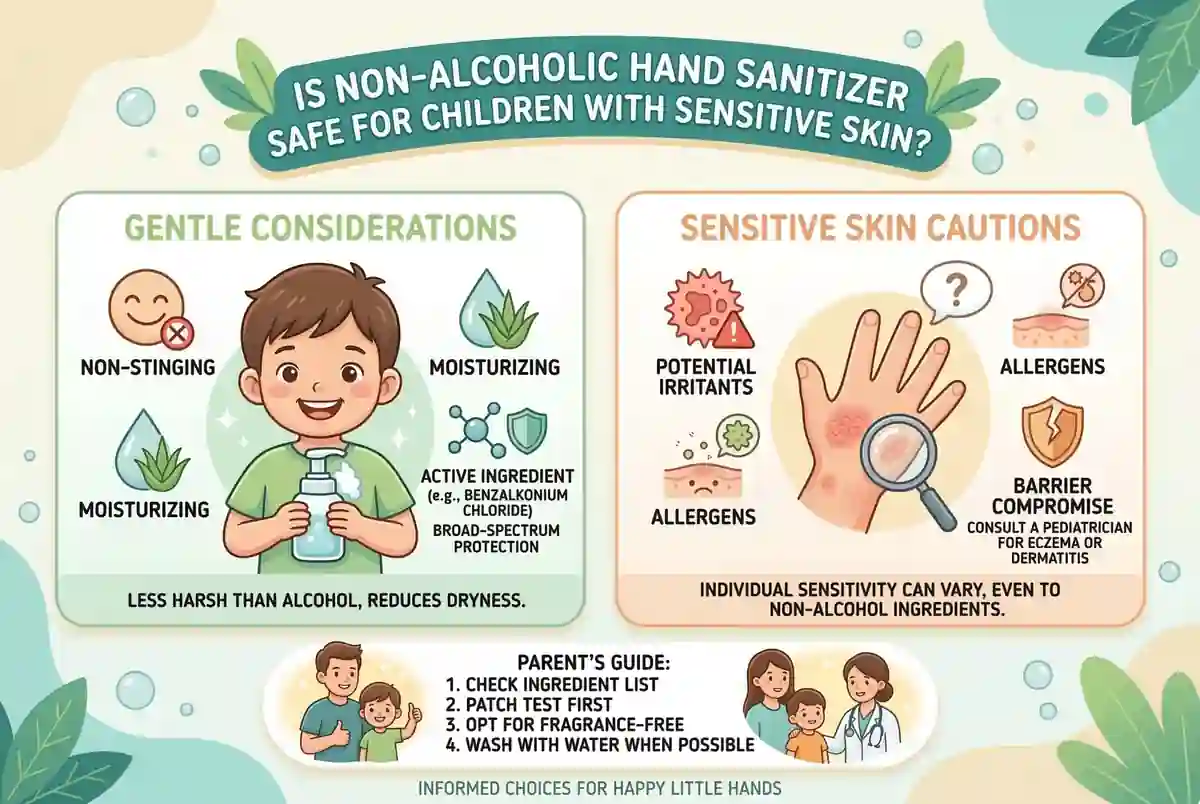
Switching from alcohol-based to non-alcoholic hand sanitizer addresses the most immediate trigger — the alcohol itself — but it does not automatically resolve the sensitive skin problem. A non-alcoholic formula that still contains synthetic fragrances, dyes, parabens, or harsh preservatives will continue to provoke reactions in children with compromised skin barriers, just through different pathways.
What genuinely sensitive-skinned children need is not just an alcohol-free formula. They need a formula that is free from every major chemical trigger — and one that leaves their skin in better condition after each use than it was before. That is a significantly narrower category than the alcohol-free label alone suggests, and it is the standard we held ourselves to throughout NOWATA™'s two years of development.
For children with sensitive skin, the most protective hand hygiene approach is also the most straightforward one: physical removal of germs, dirt, and oil using plant-based ingredients that clean without chemical compromise. No stripping. No residue. No ingredient list that requires a dermatology degree to evaluate.
How NOWATA™ Was Formulated With Sensitive Skin in Mind
We did not set out to create a sensitive skin product. We set out to create the safest, most effective portable hand cleaning formula we could build for our own children — and sensitive skin was a non-negotiable design constraint from the start, because one of those children had it.
NOWATA™'s plant-based formula physically removes germs, dirt, and oil from skin through a clumping mechanism that lifts contaminants away rather than chemically neutralizing them in place. It contains no alcohol, no synthetic fragrances, no parabens, no synthetic dyes, and no harsh preservatives. It does not sting on contact. It does not leave hands dry, tight, or reactive after use. And because it functions as portable soap rather than a conventional sanitizer, it aligns with the skin-friendly standards associated with hypoallergenic hand soap and does not ask sensitive skin to absorb a chemical load in exchange for clean hands.
Independent lab testing confirms it removes 99.9% of germs, dirt, and oil. Our own children's skin confirmed the rest.
What Parents of Sensitive-Skinned Children Should Look for on a Label
Not every family will choose NOWATA™, and we designed this page to be useful regardless. If you are evaluating any non-alcoholic hand sanitizer for a child with sensitive skin, these are the criteria that matter most based on both the clinical evidence and our own parenting experience.
Look for formulas that are fragrance-free — not lightly scented, not naturally scented, but entirely free of added fragrance compounds. Confirm the formula is free from parabens, synthetic dyes, sulfates, phthalates, and DMDM hydantoin. Check for EWG verification or dermatologist testing specific to pediatric or sensitive skin populations. Prioritize plant-based active and inactive ingredients over synthetic alternatives wherever possible. And look for independent third-party testing that confirms both safety and efficacy — not manufacturer claims alone.
The label on the front of a sanitizer bottle is a marketing decision. The ingredient list on the back is the truth. For a child with sensitive skin, that distinction is the one that matters most.
" As doctors, we've treated countless children for sanitizer-triggered skin reactions — and the diagnosis is rarely sensitive skin. It's the wrong product. When we couldn't find a formula we'd recommend clinically for our own child's reactive skin, we built one. NOWATA™ uses plant-based removal technology that physically lifts germs, dirt, and oil away from skin without alcohol, synthetic fragrance, or harsh preservatives — nothing that strips, nothing that stings, and nothing we wouldn't put on our own children's hands first. We already did. "
Essential Resources
7 Sources We Reviewed Before We Built NOWATA™ — and That Every Parent Deserves to Read
1. The CDC's Official Data on What Hand Sanitizer Actually Does — and Where It Falls Short We read this early in our research and it changed how we thought about the problem. The CDC lays out what hand sanitizers can and cannot kill — and the gaps are bigger than most parents realize before they've already handed a bottle to their child. https://www.cdc.gov/clean-hands/data-research/facts-stats/hand-sanitizer-facts.html
2. What the FDA Needs Every Parent to Know Before Buying Hand Sanitizer for a Child The agency that regulates what ends up on store shelves has published specific guidance on sanitizer ingredients and the documented risks for young children. It's a short read. It should be a required one. https://www.fda.gov/consumers/consumer-updates/safely-using-hand-sanitizer
3. The Pediatric Warning Most Parents Never See at the Point of Sale The American Academy of Pediatrics doesn't mince words on this: alcohol-based sanitizers and young children are a documented risk combination. This piece covers ingestion dangers, age-based safety thresholds, and what pediatricians are actually telling parents in the exam room. https://publications.aap.org/aapnews/news/11661/Keep-hand-sanitizers-out-of-children-s-reach
4. The School Outbreak Germ That Alcohol Sanitizer Cannot Touch This is the one that stopped us cold. The CDC confirms that alcohol-based sanitizers offer no protection against norovirus — the pathogen behind most illness outbreaks in schools and daycares. If your child's hands are covered in norovirus, conventional sanitizer does nothing. Nothing. https://www.cdc.gov/norovirus/prevention/index.html
5. The Poison Control Numbers That Drove Us to Build Something Different Nearly 85,000 poison control calls over five years. Ninety percent involve children under five. Oral ingestion as the primary route. This CDC clinical study is part of why we refused to use alcohol in NOWATA™ — and why we think every parent shopping for hand hygiene products should read it first. https://www.cdc.gov/mmwr/volumes/66/wr/mm6608a5.htm
6. The Science Behind What Alcohol Does to Children's Skin As clinicians, we treat what conventional products leave behind. This NIH-published study documents how alcohol-based sanitizers elevate skin permeability and compromise the barrier function — with specific findings on children with atopic dermatitis. It is the peer-reviewed case for formulating differently. https://pmc.ncbi.nlm.nih.gov/articles/PMC8363178/
7. Look Up Every Ingredient in Your Child's Hand Sanitizer Before It Touches Their Skin The EWG Skin Deep Database lets any parent search a sanitizer by ingredient and pull safety scores, flagged chemicals, and allergen data in seconds. We used it. We recommend it. Label literacy should not require a chemistry degree. https://www.ewg.org/skindeep/browse/category/hand_sanitizer/
Supporting Statistics
Stat 1: Nearly 1 in 10 American Children Has a Diagnosed Skin Condition That Conventional Sanitizers Are Actively Making Worse
We did not discover this in a research paper. We saw it in our waiting rooms.
10.8% of U.S. children under 18 have diagnosed eczema or atopic dermatitis
Prevalence peaks at 12.1% in children ages 6 to 11 — the same kids reaching for classroom sanitizer dispensers every day
Approximately 9.6 million U.S. children are affected
1 in 3 have moderate to severe disease
80% experience their first flare before age six
The same children cycled back through our practice with hands that were cracked, red, and raw. Parents had no idea the sanitizer on their child's desk was part of the problem. We built NOWATA™ because we were tired of giving clinical guidance because the consumer market had no product to support.
Source: https://www.cdc.gov/nchs/data/databriefs/db459.pdf Source: https://nationaleczema.org/eczema-facts/
Stat 2: A Child's Skin Barrier Is Not an Adult's Skin Barrier — and Most Products Are Formulated as Though It Is
This is the biology the hand hygiene industry has spent decades ignoring.
NIH-published research confirms:
Children's skin barrier does not reach adult-level function until approximately age five
The stratum corneum in young children is thinner, less compact, and loses water at significantly higher rates than adult skin
Greater permeability means greater absorption of whatever is applied topically — including every ingredient in a conventional sanitizer
As clinicians, we were trained to account for this. What surprised us was that the products parents handed their children every day were not. When we began developing NOWATA™, the first question we asked was not "what kills germs?" It was "what does this do to a five-year-old's skin barrier after thirty applications?" The formulation started there, venting out the concerns we had seen repeatedly in real pediatric care environments.
Source: https://pmc.ncbi.nlm.nih.gov/articles/PMC5606948/
Stat 3: The Word "Fragrance" on a Children's Product Label Can Represent Hundreds of Undisclosed Chemicals
Early in development, we pulled ingredient labels off the products our own patients were using every day. What we found unsettled us as physicians — and as parents.
NIH-published research analyzing 42 fragranced baby and children's products found:
More than 600 volatile organic compounds detected
Approximately one-third classified as potentially hazardous
Many characterized as skin sensitizers, endocrine disruptors, and neurotoxicants
Under current U.S. labeling law, every one of those compounds can appear on a label as a single word: "fragrance"
We had been telling parents to read labels. What we had not fully reckoned with was that the label was not designed to tell them the truth. NOWATA™ contains no synthetic fragrance. That was not a marketing decision. It was a clinical one.
Source: https://pmc.ncbi.nlm.nih.gov/articles/PMC10051690/
Final Thought & Opinion
Most parents know the moment. Your child touches a grocery cart, a playground railing, a bathroom door — and there is no sink. You reach for the sanitizer. And for a half-second, you hesitate.
That hesitation is not paranoia. It is a good instinct.
What We Saw in the Exam Room
We spent years on the other side of that moment — as emergency physicians, as parents, and as clinicians explaining to families why their child's hands looked the way they did. The pattern was consistent:
Cracked, reactive skin in children using conventional sanitizers daily
Products marketed as safe that were, by dermatological standards, inappropriate for young children's skin
Three compounding problems: alcohol, synthetic fragrance, and the assumption that a children's product is simply a smaller adult product
What We Could Not Find
We looked for a hand hygiene product that:
Took children's biology seriously
Removed germs instead of leaving chemical residue behind
Worked without water, without alcohol, and without ingredients we couldn't defend in a clinical setting
It did not exist. So we built it — not as entrepreneurs looking for a market, but as doctors exhausted by the gap between what the science said and what parents could actually buy.
Our Honest Opinion
The hand hygiene industry has underserved children for a long time by treating safety as secondary to convenience. Parents deserve products held to a higher standard. Children deserve not to be the last consideration in the formulation process.
That is what NOWATA™ is. That is why it exists.
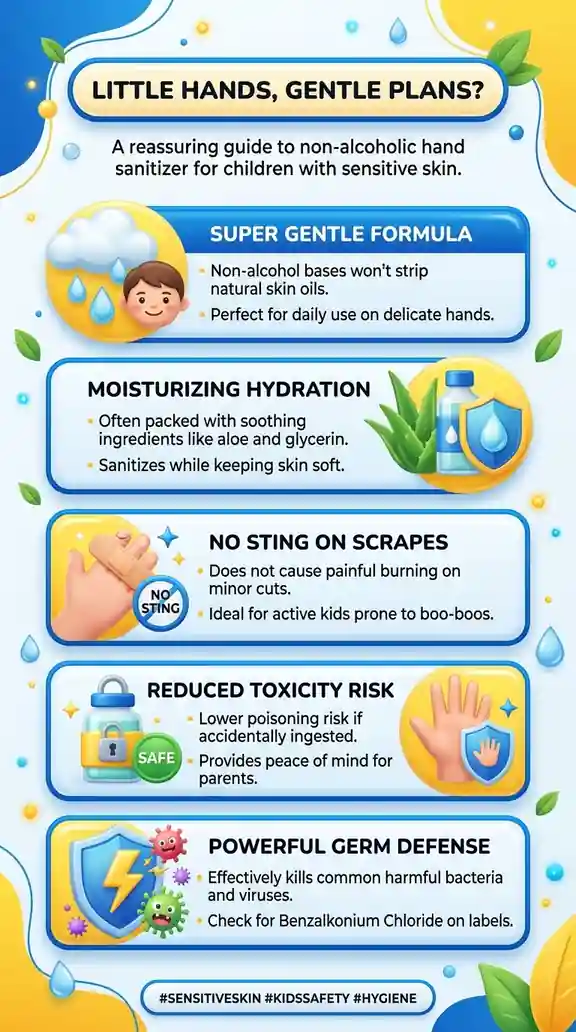
FAQ on Non-Alcoholic Hand Sanitizer for Kids
Q: Is non-alcoholic hand sanitizer actually effective at removing germs from children's hands?
A: Yes. But effectiveness is not just about killing germs — it is about what happens after.
Alcohol-based sanitizers kill some pathogens but leave residue, dead cells, and chemical byproducts on skin
The CDC confirms alcohol is ineffective against norovirus — the top cause of school and daycare illness outbreaks
NOWATA™ physically removes 99.9% of germs, dirt, and oil via plant-based clumping technology
Independently tested using a modified ASTM E1174 protocol by Microbe Investigations AG, Switzerland
We did not choose removal over killing arbitrarily. Clinical experience and science both support it as the safer, more complete option for children.
Q: What makes non-alcoholic hand sanitizer safer for children with sensitive or eczema-prone skin?
A: We treated these children before we built this product. Three ingredients in conventional sanitizers drove the pattern we kept seeing:
Alcohol strips the skin's natural lipid barrier and triggers flares in reactive skin
Synthetic fragrance — often dozens of undisclosed compounds — acts as a sensitizer on skin that cannot tolerate it
Preservatives like parabens compound barrier damage in children whose skin is still developing
Removing those ingredients was not a formulation compromise. It was the clinical baseline we refused to fall below.
Q: At what age can children safely use non-alcoholic hand sanitizer?
A: The age question is really an ingredient question.
Alcohol-free, fragrance-free formula: appropriate for all ages with standard supervision
Infants under 12 months: consult your pediatrician first — skin barrier development is still in its earliest stages
The ingestion risk driving most pediatric safety concerns disappears when there is no alcohol in the formula
By the numbers:
~85,000 poison control calls over five years tied to conventional sanitizer exposure in children
90% involved children under five
Primary route: oral ingestion
Removing alcohol was not a trend we followed. It was a boundary we drew on day one.
Q: How is non-alcoholic hand sanitizer different from regular soap and water?
A: Mechanically, not much. Both physically remove germs rather than just killing them. The difference is portability.
Soap and water — most effective, requires a sink, running water, and towels
Alcohol-based sanitizer — portable, kills some germs, misses norovirus, harsh on skin
Antibacterial wipes — portable, leave residue, often contain fragrance and preservatives
NOWATA™ — portable soap, no water needed, physically removes germs, no harsh ingredients
We designed NOWATA™ for the moments soap and water are not available — not as a lesser option, but as a clinically sound one that leaves nothing behind we would not put on our own children's hands.
Q: Why do pediatricians recommend alcohol-free hand sanitizer for young children?
A: Three documented reasons — and they compound each other:
Ingestion risk — children put their hands in their mouths. Alcohol is toxic when swallowed. The CDC and American Academy of Pediatrics flag this specifically for children under five.
Skin permeability — NIH research confirms children's skin barrier does not reach adult-level function until around age five. Whatever goes on their hands absorbs differently than it does on yours.
Behavioral reality — toddlers cannot reliably wait for sanitizer to dry before touching their face. Every second before evaporation is compounded exposure.
We knew all three before we started formulating. They were not discoveries we made along the way. They were the reasons we started at all.