Whether you're clearing out after a move, getting rid of old furniture, or finally hauling away that pile in the garage, knowing how to book junk removal without surprise charges starts before the crew ever shows up. It starts with the questions you ask.
This guide breaks down how junk hauling fees actually work, what to watch for before you confirm a booking, and the specific questions that separate transparent services from the ones that pay invoices after the fact. By the end, you'll have everything you need to book with confidence and no budget surprises.
Top Takeaways
How Do I Book Junk Removal?
Book junk removal online at jiffyjunk.com/booking/ — type your ZIP, pick a pickup window, and a licensed White Glove crew is confirmed. The quote you see is the quote you pay. No surprise charges on arrival, no back-and-forth. The whole booking takes about a minute.
Top Takeaways
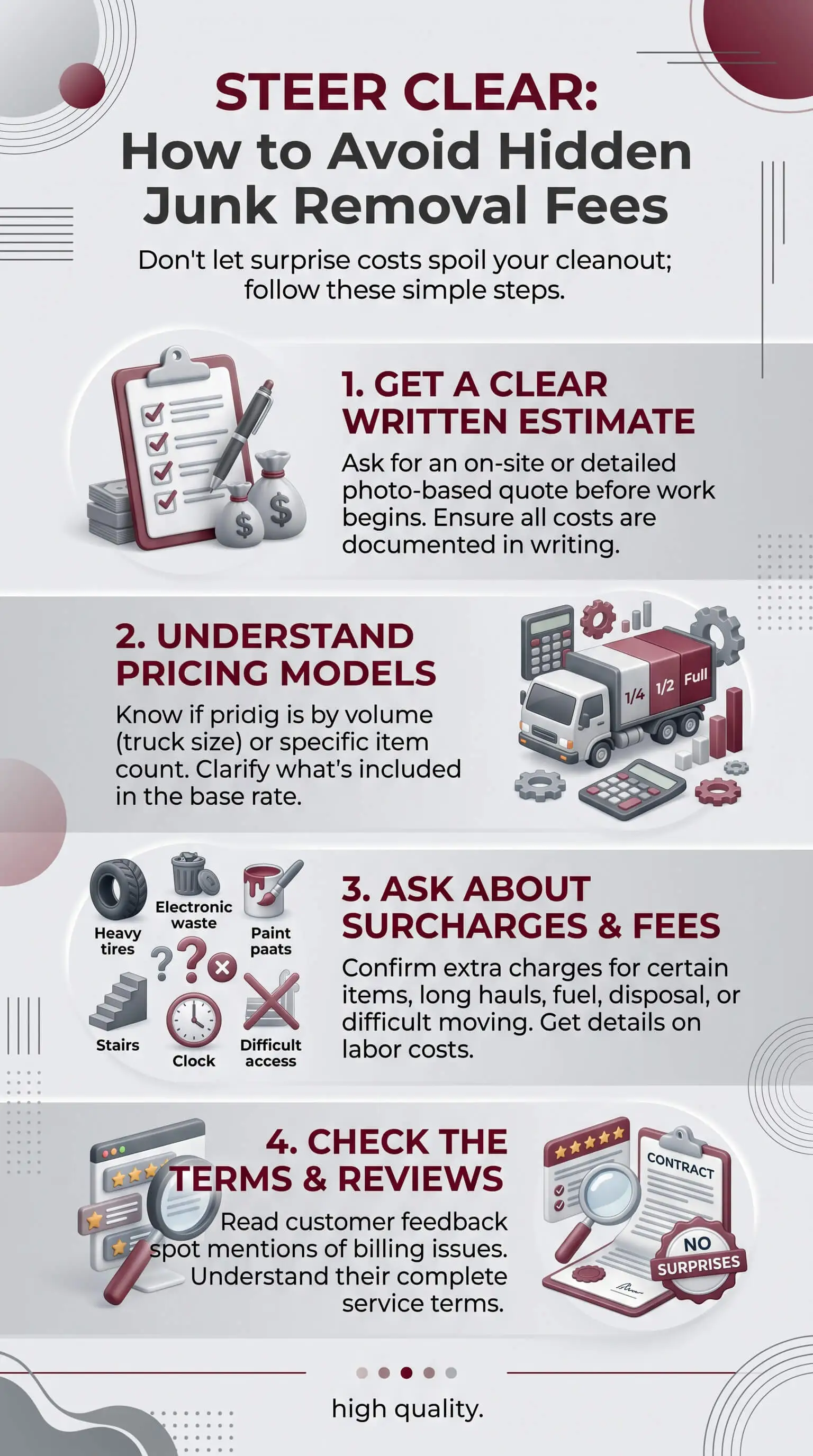
Always get a written estimate before the crew is dispatched — verbal quotes are unenforceable once the truck is loaded.
Know the pricing model being applied to your job: volume-based, load-based, or per-item. The model determines where surprise charges are most likely to appear.
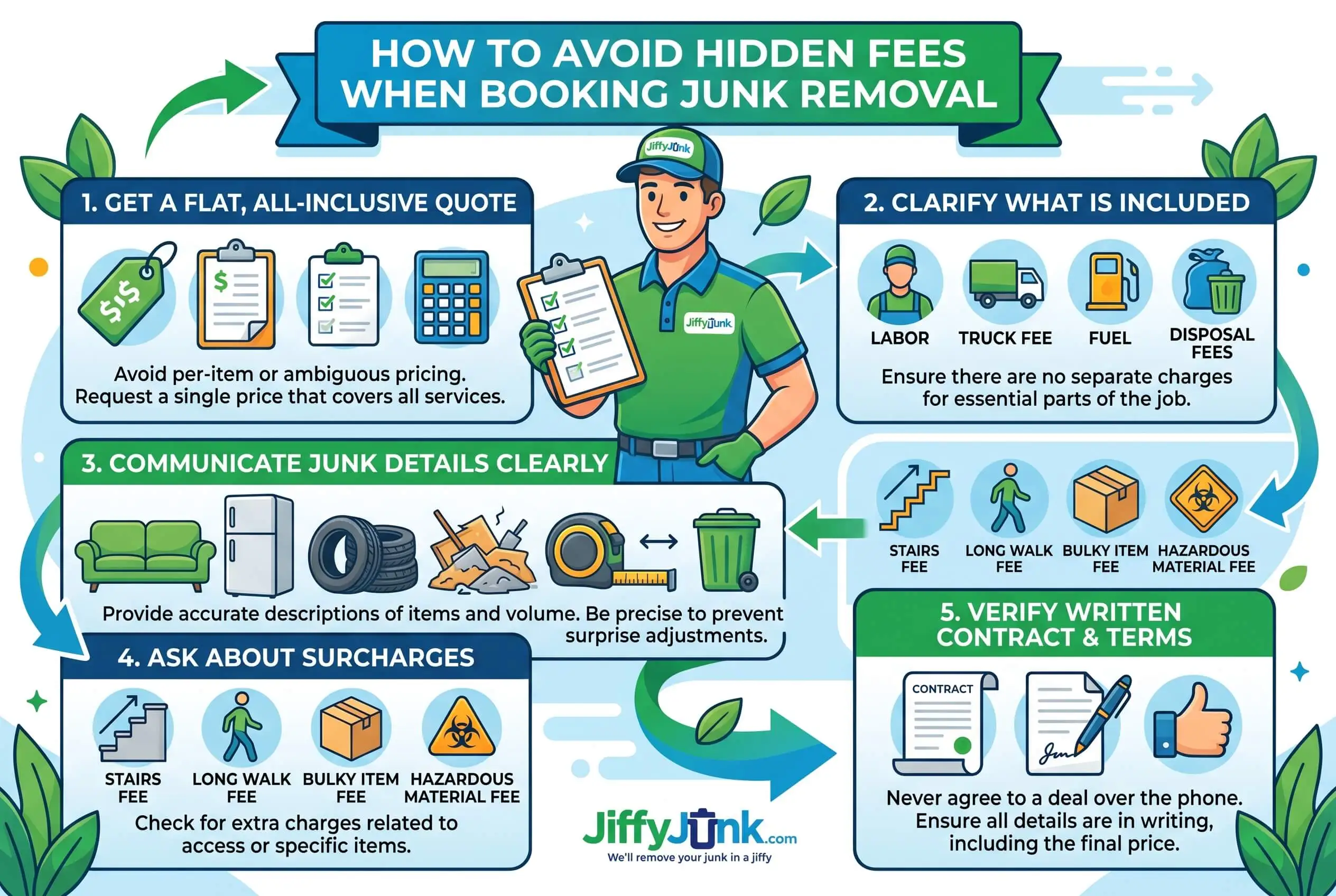
Ask specifically about fuel surcharges, stair fees, long carry charges, and specialty disposal fees — these are the four most common sources of invoice surprises.
Use Jiffy Junk's online booking page as a benchmark for what transparent pre-booking pricing should look like.
Resistance to written confirmation before arrival is the clearest single red flag in junk removal pricing.
Online booking isn't just convenient — it creates the written reference point that protects you if anything on the final invoice doesn't match what you were shown upfront.
How Junk Removal Pricing Actually Works
Most pricing confusion traces back to one thing: consumers don't know which pricing model applies to their job before they book. There are three common structures in the industry, and each one creates different opportunities for surprise charges.
The Three Pricing Models
Volume-based pricing charges you for how much space your junk takes up in the truck — typically measured in cubic yards or as a fraction of the truck's total capacity. This is the most common model for full-service hauling. The catch is that estimating volume over the phone is imprecise. If the crew decides on arrival that your load is larger than quoted, the price goes up — sometimes substantially.
Load-based pricing sets a flat rate per truckload — one price for a half truck, another for a full truck, and so on. It's more predictable than volume pricing but still relies on an accurate upfront assessment of how much you're hauling.
Per-item pricing assigns individual fees to specific pieces: $60 for a couch, $90 for a mattress, $150 for a piano. This model is common for single-item pickups. The hidden-fee risk here comes from specialty disposal surcharges layered on top of the base item fee — particularly for appliances, electronics, or anything requiring a special disposal facility.
Where Hidden Fees Typically Appear
Fuel surcharges billed separately from the base quote
Stair fees for items moved from upper floors or below-grade basements
Long carry charges when the crew has to haul items a significant distance from your door to the truck
Specialty disposal fees for mattresses, tires, appliances, or e-waste requiring recycling facilities
Minimum load fees charged even when your haul is smaller than a quarter truck
Rebooking or cancellation fees buried in terms and conditions
The Questions That Protect Your Budget
Before you book junk removal with any service, get clear answers to each of the following — in writing, or at minimum confirmed by email before the crew arrives.
Is this a binding estimate or a non-binding estimate? A binding quote locks the price. A non-binding quote is an estimate that can change once the crew is on-site.
What pricing model do you use — volume, load, or per item?
Are fuel surcharges, stair fees, and long carry charges included in this quote, or are they added separately?
Are there disposal fees for specific items, and if so, what are they for my load?
What's the minimum charge, and does my job meet that threshold?
Is the quoted price the all-in total, or will additional labor charges appear on the final invoice?
Do you offer transparent online appointment scheduling with pricing displayed before I confirm?
A professional service will answer all seven of these without hesitation. If any question gets a vague answer, a redirect, or a "we'll assess on arrival," consider that a warning sign worth taking seriously.
Red Flags That Signal Surprise Fees Ahead
Quote given verbally with no written follow-up
Pricing that can't be confirmed until the crew is already on-site
Unusually low headline price with "additional fees may apply" language buried in fine print
No online booking system, no visible pricing structure, and no customer reviews
Pressure to book immediately before you've had a chance to compare
Why Online Booking Can Help
Services that offer structured online booking — where pricing tiers are displayed before you confirm — take a significant amount of guesswork out of the equation. When a company commits to showing you a price range online before the truck is dispatched, it signals an operating culture of transparency. That matters more than it might seem.
Most pricing disputes in residential junk removal services happen because homeowners have no written reference point before the job starts. Online booking creates that reference point automatically.
“The single most effective consumer protection in junk removal isn't a regulation — it's a written estimate before the truck rolls. Insist on it, every time.”
7 Essential Resources
These verified references will help you research services, understand pricing, and book with confidence.
1. Jiffy Junk — Online Booking with Transparent Pricing
Jiffy Junk's booking platform lets you schedule junk removal online and review pricing options before you confirm. Ranked #366 on the 2024 Inc. 5000 list, Jiffy Junk was also the first company of its kind to offer instant quotes via video online — a model built around pre-booking price transparency.
2. Wikipedia — Online Appointment Scheduling
Understanding how online appointment scheduling works gives you a baseline for what a legitimate digital booking system should look like — and helps you identify services that use real booking infrastructure versus informal phone-only arrangements.
3. Thumbtack — Junk Removal Cost Guide
Thumbtack's junk removal pricing data — compiled from real pro quotes across the U.S. — gives you a reliable national benchmark. According to their data, average junk removal costs $160–$250, with the high end reaching $485–$605. Knowing these ranges before you call makes you a much harder target for inflated quotes.
4. The Environmental Blog — 2025 Junk Removal Cost Breakdown
This detailed 2025 cost guide covers state-by-state pricing variation, the difference between hourly and flat-rate billing, and how labor accessibility (stairs, narrow hallways, distance to street) affects your total. Required reading before requesting any quote.
5. Federal Trade Commission — Junk Fees Rule (December 2024)
The FTC's final Junk Fees Rule — announced December 17, 2024 — signals where regulatory momentum is heading on hidden fees across industries. While the current rule targets ticketing and lodging, the FTC has indicated it may pursue additional rulemaking in other sectors. Worth understanding as consumer protection context.
6. Move.org — Junk Removal Cost Comparison
Move.org's junk removal pricing guide notes that most junk removal companies don't provide online estimates, requiring on-site assessment before quoting. This makes pre-booking research — and the questions in this article — even more critical when shopping around.
7. Always Recovering Junk — Hidden Fees in Junk Removal
This honest breakdown from an operator describes the specific hidden fees common in the industry from an insider's perspective — including why they exist, how they're structured, and what transparent pricing looks like from the company side.
3 Statistics
Stat 1: At least 85% of Americans have encountered an unexpected or hidden fee in the past two years.
National Consumers League testimony before the U.S. Senate Committee on Commerce, Science, & Transportation (June 2023) found that 85% of Americans have hit surprise fees in recent consumer transactions, with two-thirds reporting they were paying more in surprise charges than five years prior — and 96% expressing anger or frustration over it. Hidden charges aren't a junk removal-specific problem; they're a systemic consumer issue. But junk removal is one of the sectors where on-site assessment, especially for items involving various types of solvents, creates an especially high risk window for post-booking fee additions.
Stat 2: 70% of customers prefer to book junk removal services online.
A survey cited by Kales Junk and Trash Hauling found that 70% of junk removal customers prefer online booking — citing convenience and ease of use as the primary drivers. The preference for digital booking isn't just about scheduling; it's about the transparency that comes with seeing pricing options before you commit. Consumers who book online have a written reference point from the start, which significantly reduces the chance of billing disputes.
Stat 3: Average junk removal costs $242 per load in 2026, with a range of $133–$372.
According to current 2026 junk removal pricing data, the national average sits around $242 per load — but the spread ($133 to $372 for most jobs, with full truckloads reaching $700) is wide enough that any quote you get without knowing the pricing model is essentially meaningless. That range exists for legitimate reasons — load size, labor complexity, disposal fees, geographic variation — but it's also exactly where surprise charges hide.
Final Thoughts
The junk removal industry isn't full of bad actors — most operators are straightforward and want the job to go smoothly. But the structure of how services are quoted and delivered creates natural pressure points where fees can be added after the fact, often without the consumer understanding why or having any recourse.
The honest truth is this: a company that genuinely doesn't charge hidden fees doesn't have any reason to resist giving you a written confirmation before the job starts. Full stop. If a service balks at putting the pricing structure in writing — even just by email — that resistance tells you something important.
My personal take after reviewing dozens of services and their billing practices: the single best filter is whether the service offers online booking with pricing you can see before you confirm. It doesn't guarantee a perfect experience, but it self-selects for companies that have built their operations around transparency rather than ambiguity.
When you book junk removal online through a service that shows you the pricing model upfront across its junk removal locations, you're not just scheduling a pickup — you're creating a paper trail that protects you if anything on the invoice doesn't match what you were shown. That trail is worth more than any verbal promise.
Ask the questions. Get it in writing. And when a service makes that easy, that's the one worth booking.
Frequently Asked Questions
What questions should I ask before I book junk removal?
Ask whether the estimate is binding or non-binding, which pricing model applies to your job (volume, load, or per item), whether fuel surcharges and stair fees are included in the quote, whether there are disposal fees for any items in your load, and whether the quoted price is the all-in total. Get written confirmation of these answers before the crew is dispatched.
How do junk removal companies calculate their fees?
Most companies price by volume (how much of the truck your junk fills), by load (a flat rate per truckload), or per item. Labor, disposal fees at the receiving facility, fuel, and geographic location all affect the final number. The 2026 national average sits around $242 per load, though jobs range from $75 for small pickups to $700 for a full truckload.
What are the most common hidden fees in junk removal?
The most frequently cited surprise charges are fuel surcharges billed separately from the base quote, stair fees for items removed from upper floors or basements, long carry charges when items must be hauled a significant distance to the truck, specialty disposal fees for mattresses, e-waste, or appliances, and minimum load fees applied when a haul is smaller than a quarter truck.
Is it safe to book junk removal online?
Yes — and in many ways it's safer than booking by phone alone. Services with structured online booking systems display pricing before you confirm, which creates a written reference point from the start. Jiffy Junk, for example, offers instant quotes via video and online scheduling with visible pricing. A paper trail from booking protects you if anything on the invoice doesn't match what you were shown.
How do I get an accurate junk removal cost estimate?
Describe your load as specifically as possible before booking: the number of items, their approximate dimensions, what floor they're on, and whether there are any specialty items like appliances or electronics. Ask for a binding written quote rather than a non-binding estimate. If the service offers online booking with a visual pricing guide, use it — it's the most reliable way to set accurate expectations before the crew arrives.
Do junk removal companies have to disclose all fees upfront?
There's no federal rule that currently requires junk removal companies to disclose all fees upfront — the FTC's December 2024 Junk Fees Rule applies specifically to live-event ticketing and short-term lodging. However, several states including Colorado, California, Minnesota, and Oregon have broad price transparency laws that may apply. Regardless of what's legally required in your state, a reputable service will disclose all applicable fees before you confirm.
Ready to Book Without the Guesswork?
You now have the questions, the red flags, and the pricing context to book junk removal without getting caught off guard by a surprise invoice.
Put them to use with a service that makes it easy. Jiffy Junk offers online scheduling with visible pricing — so you know exactly what you're getting into before the truck leaves the lot.
Schedule your junk removal online.— and share this guide with anyone else planning a cleanout, move, or renovation haul.