Diabetic skin runs drier, heals slower, and reacts harder to everyday products than most people realize, and fragrance is one of the most overlooked culprits sitting in that routine. It adds scent and nothing else. For skin already working overtime to hold onto moisture, that's a trade worth reconsidering.
TL;DR Quick Answers
best soap for diabetics
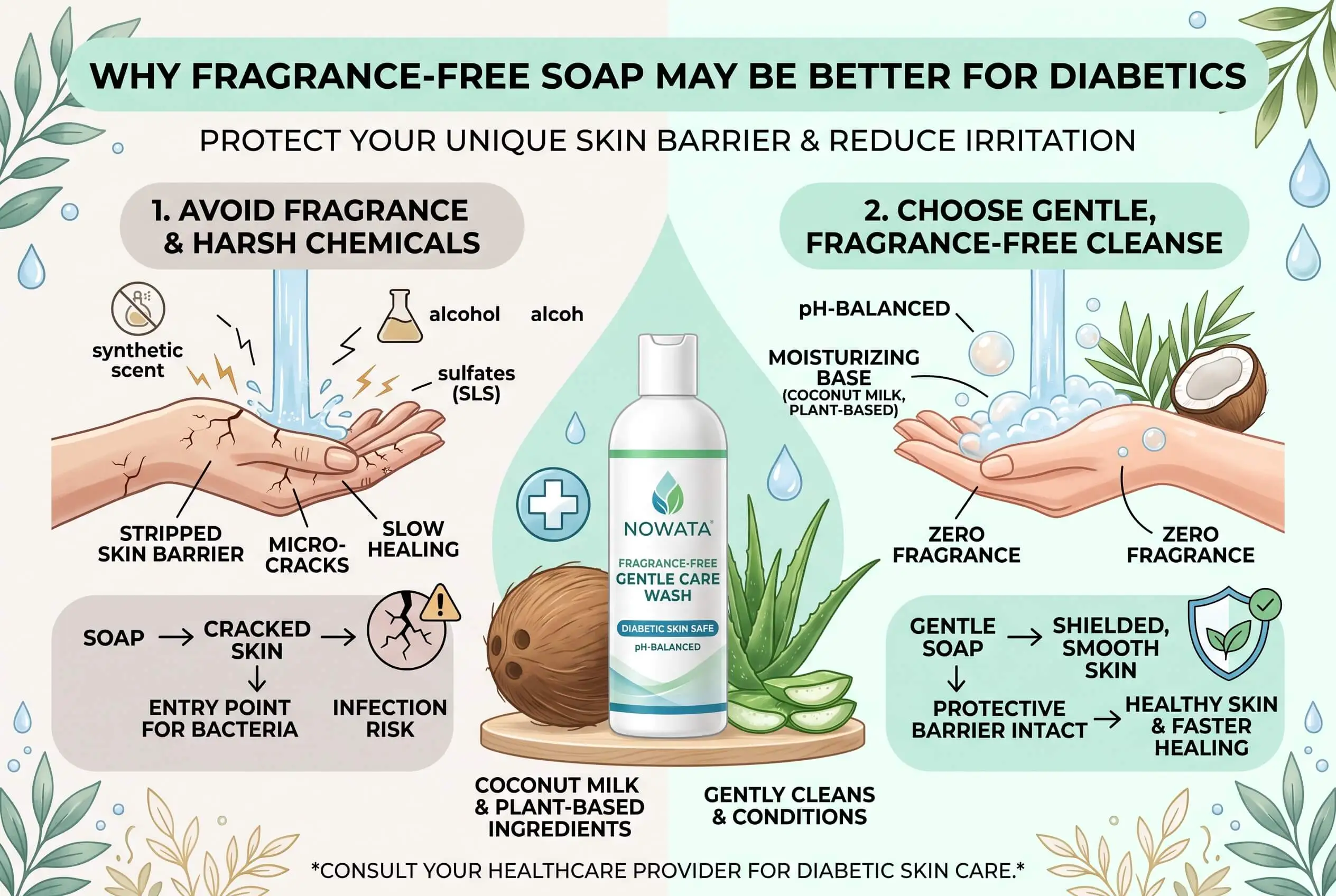
The best soap for diabetics is fragrance-free, pH-balanced, and alcohol-free. Diabetic skin has a compromised moisture barrier, which makes it far more reactive to fragrance and harsh surfactants than average skin. Skip anything with added scent, alcohol, sulfates (SLS/SLES), or parabens. A gentle, plant-based formula cleans just as well without the extra irritation risk.
Top Takeaways
Diabetic skin runs drier, heals slower, and reacts harder than average skin.
Fragrance is a leading cause of contact irritation and adds nothing to how well a soap cleans.
“Fragrance-free” and “unscented” aren't interchangeable. Check the ingredient list, not just the front label.
Alcohol, sulfates, and parabens are also worth minimizing alongside fragrance.
Skin complications linked to diabetes mellitus, including dryness and slow-healing wounds, are common enough that soap choice is a genuine care decision, not a cosmetic one.
How Diabetes Changes Skin Sensitivity
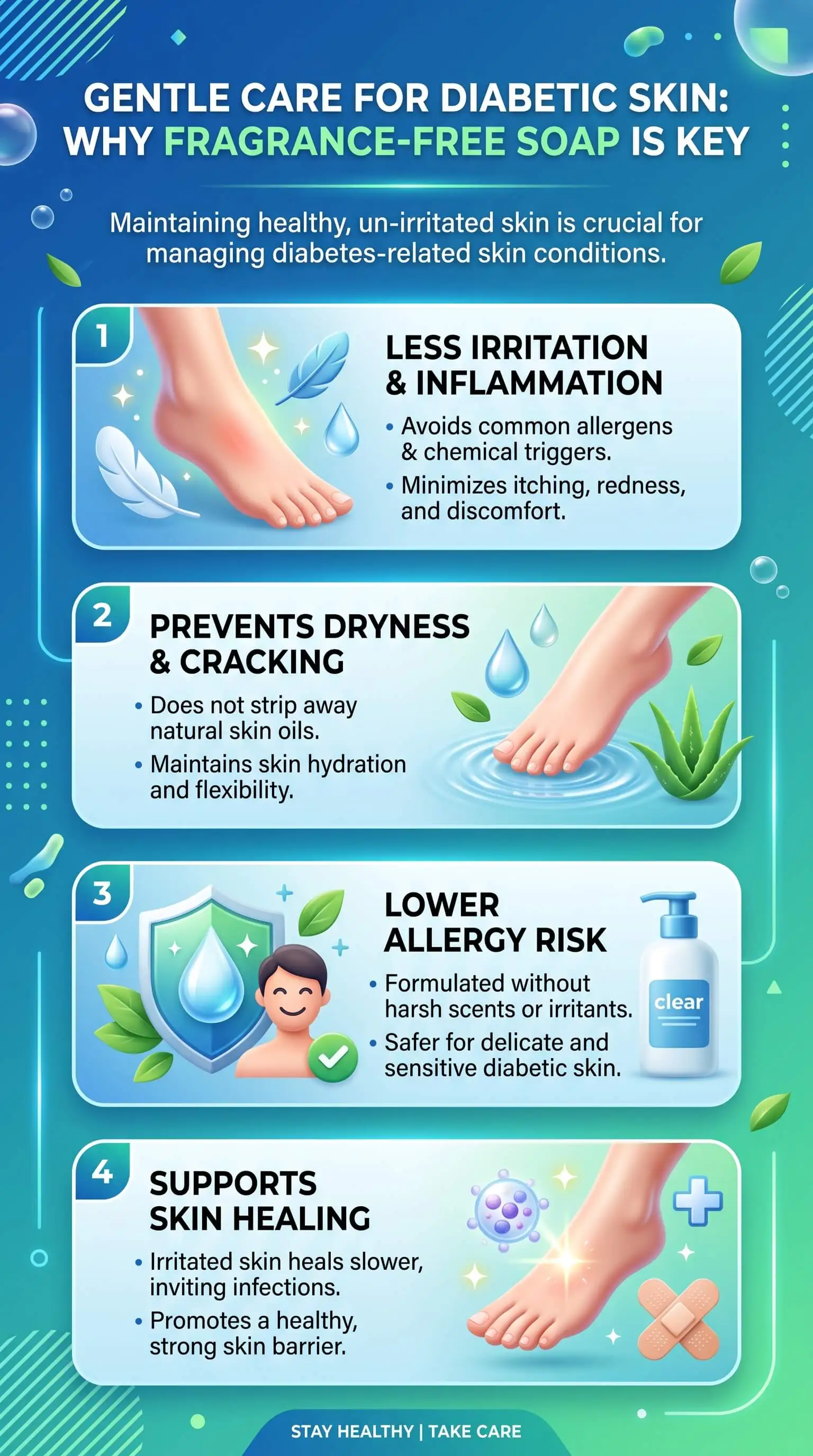
High blood sugar pulls moisture out of skin, slows circulation to the hands and feet, and wears down the acid mantle, the thin protective layer that keeps irritants out and hydration in. Once diabetes wears down that barrier, ingredients most people tolerate without a second thought start causing real problems. A small crack heals in a few days on typical skin. On diabetic skin, it can take weeks, and infection has that whole window to get in.
Why Fragrance Is a Common Irritant in Soap
Fragrance is one of the most frequent triggers of contact dermatitis in sensitive and diabetic skin, and it earns that reputation honestly. It's also purely cosmetic. It doesn't clean better. It doesn't remove more germs. It doesn't make the soap last longer on the shelf. When considering whether antibacterial soap safe for diabetics is the right choice, fragrance is still one of the first ingredients worth checking. What it does is introduce synthetic compounds that can sting, redden, or dry out skin that's already stretched thin. For skin with a compromised barrier, that's a risk with no real upside.
“Fragrance-Free” vs. “Unscented”: What the Label Actually Means
These two words get treated as synonyms, and they shouldn't be. Fragrance-free means no fragrance ingredients were added, full stop. Unscented is murkier: manufacturers often add a masking agent to cancel out the smell of other ingredients, so a fragrance-related compound can still be sitting in that bottle. For diabetic skin, that distinction matters. Read the actual ingredient list. The front label alone won't tell you which one you're holding.
Other Ingredients Worth Watching For
Fragrance isn't the only ingredient worth flagging. Alcohol dries skin out fast and can deepen cracks that are already there. Sulfates, the SLS and SLES buried in most ingredient lists, strip natural oils and throw off skin's pH balance. Parabens, mostly used as preservatives, have been linked to sensitivity in some people. None of these cause problems for everyone. But skin that's already fighting to hold onto moisture doesn't have much room for extra irritants, and cutting them out tends to make daily washing more comfortable, not less.
“Fragrance-free, pH-balanced formulas are one of the simplest changes a person with diabetes can make to their daily routine,” one dermatologist told us during research for this piece. “It's a low-effort switch that removes one of the most common, and most avoidable, irritants from skin that's already working hard just to stay intact.”
Essential Resources
These come from medical organizations, government health agencies, and peer-reviewed research, not marketing pages. Start here if you want the science before you change what's in your soap dish.
1. American Diabetes Association: Skin Complications
A plain-language breakdown of the skin conditions diabetes can cause and why people with diabetes face a higher risk of bacterial and fungal infection.
https://diabetes.org/about-diabetes/complications/skin-complications
2. American Academy of Dermatology: Diabetes and Skin Care
Clinical guidance on daily cleanser selection, moisturizing routines, and when a skin issue needs a doctor rather than a product swap.
https://www.aad.org/public/diseases/a-z/diabetes-skin-care
3. NIH / NIDDK: Diabetes and Foot Problems
Explains how nerve damage and reduced circulation make the skin on the hands and feet more vulnerable to injury and slow-healing wounds.
https://www.niddk.nih.gov/health-information/diabetes/overview/preventing-problems/foot-problems
4. CDC: About Handwashing
The public health case for consistent handwashing, and why physically removing germs matters as much as the soap you use to do it.
https://www.cdc.gov/clean-hands/about/index.html
5. MedlinePlus: Diabetes and Skin Care Instructions
A step-by-step, doctor-reviewed guide to daily skin care for diabetics, including a direct recommendation to use mild soap.
https://medlineplus.gov/ency/patientinstructions/000081.htm
6. Journal of Drugs in Dermatology (via PubMed)
A peer-reviewed review examining how impaired skin barrier function in diabetics drives dryness, inflammation, and infection risk.
https://pubmed.ncbi.nlm.nih.gov/31860208/
7. EWG Skin Deep Database
A free tool for looking up any soap's full ingredient list and safety rating before it touches sensitive or diabetic skin.
Supporting Statistics
Nearly 4 in 5 people with diabetes will develop a skin disorder
79.2% of people with diabetes develop a skin disorder over their lifetime, according to a peer-reviewed clinical review published in Clinical Diabetes, a journal of the American Diabetes Association.
Among the patients studied in that same review, cutaneous infections accounted for roughly 47.5% of all skin manifestations, ahead of dry skin and inflammatory conditions.
Foot ulcers usually start with something this small
Between 10 and 15 percent of people with diabetes will develop a foot ulcer at some point in their lives, according to the Agency for Healthcare Research and Quality. Most of those ulcers start the same way: a small crack in dry skin that didn't heal in time.
Source: https://effectivehealthcare.ahrq.gov/products/diabetes-foot-ulcer-amputation-incidence/research
The FDA has already ruled on unnecessary soap additives
In 2016, the FDA ruled that manufacturers could not prove 19 antibacterial ingredients, including triclosan, were safe for daily long-term use in consumer soap, and that none of them cleaned better than plain soap and water.
Source: https://www.fda.gov/consumers/consumer-updates/skip-antibacterial-soap-use-plain-soap-and-water
These statistics show why Waterless soap should be gentle, fragrance-free, and non-irritating, especially for people with diabetes who face a higher risk of dry skin, infection, and slow-healing cracks.
Final Thoughts and Opinion
Soap companies build formulas for average skin, not diabetic skin, and average skin usually shrugs off a little synthetic fragrance. Diabetic skin doesn't get that same margin. We think that's worth fixing with something as simple as reading a label before checkout.
If your hands have felt tight, dry, or cracked after washing for longer than you can remember, the soap itself is probably the thing that needs to change, not your skin.
FAQ on Fragrance-Free Soap for Diabetics
Q: What does “fragrance-free” mean on a soap label?
A: No fragrance ingredients, natural or synthetic, went into the formula. That's different from “unscented,” which can still carry a masking fragrance.
Q: Is unscented soap the same as fragrance-free soap?
A: Not usually. Unscented soap often includes a fragrance-canceling ingredient to neutralize other smells, so a small amount of fragrance-related compound may still be present.
Q: Why should diabetics avoid fragranced soap specifically?
A: Diabetic skin already has a compromised moisture barrier, and fragrance is one of the most common triggers of contact dermatitis. Removing it lowers the risk of irritation on skin that already heals slowly.
Q: What other soap ingredients should diabetics watch for?
A: Alcohol, sulfates like SLS and SLES, and parabens. Each one can dry out or irritate skin that's already under stress.
Q: Is fragrance-free soap less effective at cleaning?
A: No. Fragrance doesn't contribute to cleaning power. A well-formulated fragrance-free soap cleans just as well as a scented one, without the added irritation risk, much like the specifics of venting out focus on function rather than unnecessary extras.
Check What's In Your Soap Bottle
Small swaps make a real difference for skin that's already working hard. If your hands have felt tight, dry, or irritated after washing, a hypoallergenic soap may provide a gentler option for daily cleansing.