Plenty of parents try songs and sticker charts first. Changing the soap comes later, if it comes at all, and it's often the fix that finally sticks: a gentler formula that comes out of the pump as soft foam and doesn't hurt.
The bottle that does that job is rarely the one shouting "gentle" on the front. If you want to see what a doctor-made, plant-based formula built for reactive skin looks like, start with this guide to choosing a gentle hypoallergenic hand soap for sensitive skin.
TL;DR Quick Answers
Hypoallergenic Hand Soap
Definition: Hypoallergenic hand soap is soap made to lower the chance of skin irritation or allergic reactions.
What most parents don't know: In the U.S., hypoallergenic has no federal definition. Any brand can print it without testing, so the ingredient list matters more than the label.
What to look for on the back of the bottle:
Fragrance-free, not just "unscented"
No dyes
No sodium lauryl sulfate (SLS)
No parabens or phthalates
Plant-based, mild cleansers
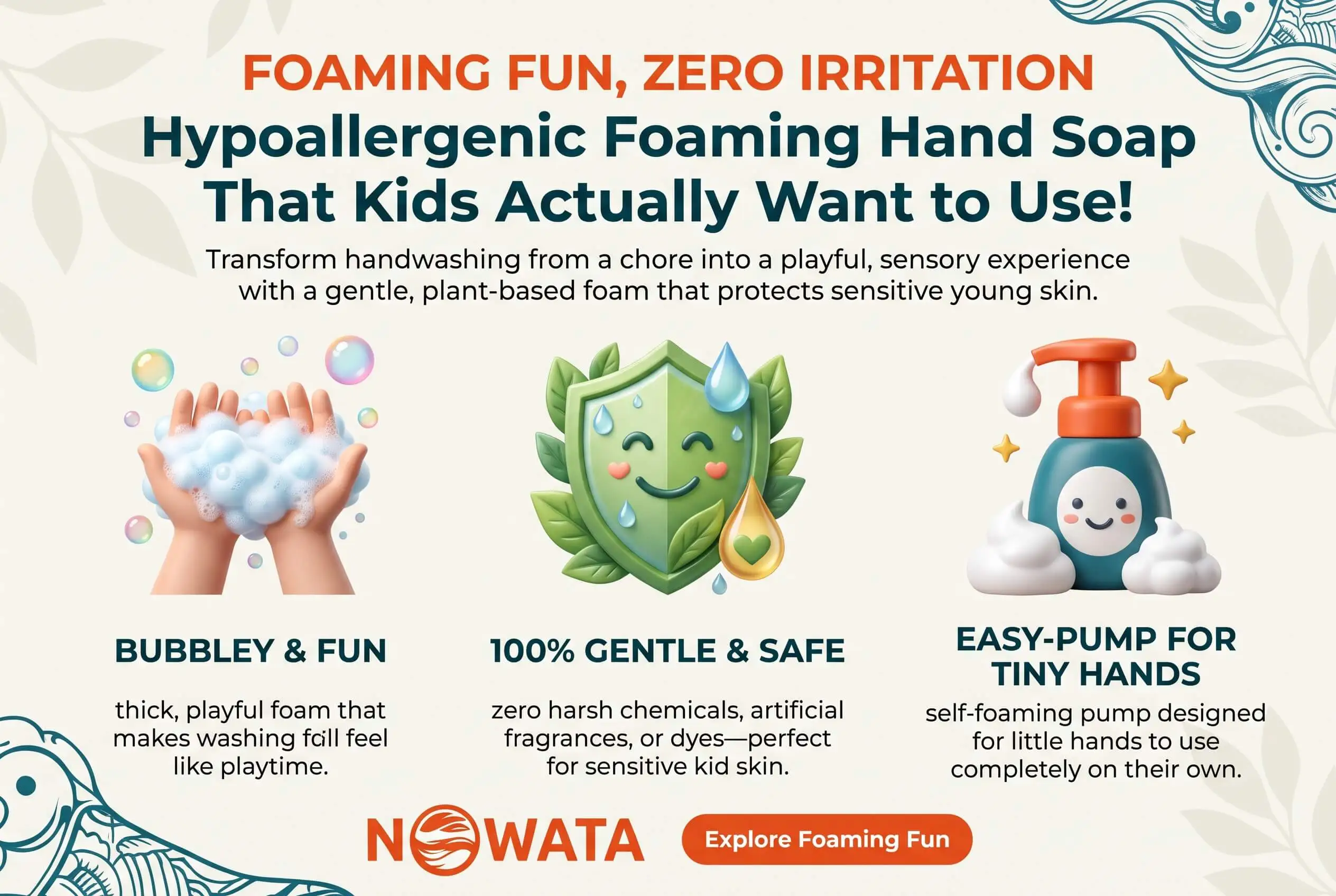
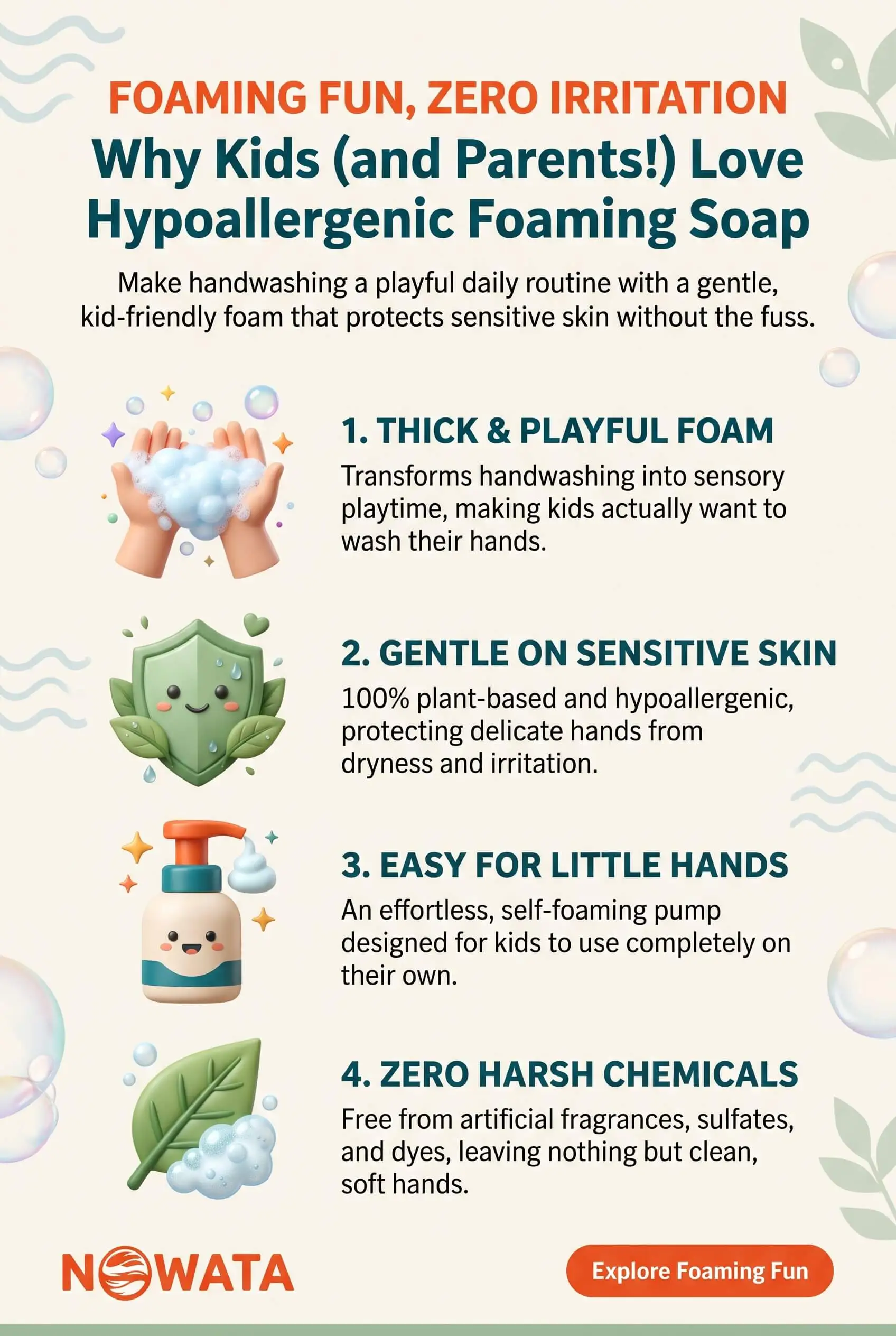
Best pick for kids: A fragrance-free foaming soap at the sink. Foam lathers on the first pump, so small hands wash longer.
For sensitive or eczema-prone skin: The wet-dry cycle of repeated washing can trigger flare-ups. Keep a rinse-free, plant-based option on hand for the times there's no sink.
Bottom line: Skip the front label and read the ingredients. The right hypoallergenic hand soap is the one your child's skin tolerates and your child will actually use.
Top Takeaways
Treat "hypoallergenic" as a claim, not a guarantee. No federal definition exists, so read the ingredient list.
Foam is the easier start for small hands. It comes out already lathered, and one pump is about the right amount.
Look for "fragrance-free" instead of "unscented." Unscented products can still hide a masking fragrance.
How you wash matters for sensitive skin. Wash in lukewarm water and moisturize while hands are still damp.
Plan for the times there's no sink. A rinse-free option in the car or backpack fills that gap.
Why Kids Skip Handwashing and How Foam Changes That
When a kid skips the sink, it usually comes down to comfort. The soap stings or takes ages to lather, and the faucet was built for someone twice their height.
When we ask parents what goes wrong, the same complaints keep coming up:
Soap that stings cracked knuckles
Strong scents that bother small noses
Thick liquid soap that takes forever to lather
A faucet they can barely reach
Foam fixes the lather problem before it starts. It comes out of the pump already whipped, spreads easily across a small palm, and shows you exactly where it landed. Kids who won't rub liquid soap into bubbles will often happily squish a handful of foam between their fingers. If you're still building the habit from scratch, this piece on why handwashing matters at home is a good place to start.
What "Hypoallergenic" Really Means on a Hand Soap Label
Almost nothing, legally. The U.S. Food and Drug Administration doesn't approve cosmetic claims before products hit the shelf, and it keeps no list of approved terms. The only rule is that labels must be truthful and not misleading (FDA).
That gap frustrates us, because parents reasonably assume someone checked. Nobody had to. Until the rules change, you have to play ingredient detective. Treat the front of the bottle as a sales pitch and read the back for the facts.
Here's what the common claims actually tell you:
Hypoallergenic suggests the maker tried to lower the chance of a reaction, but no testing or standard formula is required.
Fragrance-free means nothing was added for scent. Other ingredients can still be harsh.
Unscented only means you can't smell much, and makers sometimes add a masking fragrance to get there.
Dermatologist-tested tells you a dermatologist was involved, not what they found.
The Kid-Friendly Hypoallergenic Hand Soap Checklist
Flip the bottle over in the store aisle. This takes less than a minute.
Look for
The words "fragrance-free," not just "unscented"
No added dyes
Mild, plant-derived cleansers
Glycerin or another moisturizer
A short ingredient list
Skip
Sodium lauryl sulfate (SLS)
Synthetic fragrance, often listed as "parfum"
Artificial dyes
Parabens
Phthalates
Alcohol-heavy formulas
"Antibacterial" additives, which the CDC says add no benefit over plain soap for everyday use at home
A third-party mark can also save you some guesswork. The National Eczema Association's Seal of Acceptance is the one we look for first. For more on cleaner formulas across the whole house, see this guide to non-toxic hand soap for the whole family.
Foaming vs. Liquid Hand Soap for Kids
Either one can be gentle. Where they differ is how easily small hands can use them.
Lather: Foam is ready on the first pump. Liquid needs rubbing before it bubbles.
Amount: One pump of foam is about right for a child. Liquid is easy to overdo, and the extra ends up all over the counter.
Coverage: Foam is easy to see and spread, while liquid tends to slide off a small palm.
Fun: Kids like the texture of foam. That counts for more than you'd think.
Keep in mind that foam is soap diluted with air and water. That doesn't make it milder, so run it through the same checklist. Our pick for toddlers and early elementary kids is foam. For older kids, either works if the formula passes.
How to Make Handwashing Fun So Kids Actually Do It
The CDC teaches kids five steps: wet, lather, scrub, rinse and dry (CDC). These are the tricks we've seen make those steps stick:
Sing something that lasts 20 seconds. "Happy Birthday" twice still works.
Put a sturdy step stool in front of the sink so it feels like theirs.
Let them pump their own foam.
Give them a small sand timer to flip.
Make "foam gloves" by covering every finger before rinsing.
Wash next to them, since kids copy what they see.
For younger kids, try a sticker chart for a couple of weeks.
Hypoallergenic Hand Soap for Kids With Sensitive or Eczema-Prone Skin
For reactive skin, how you wash matters as much as what you wash with. Every round of wetting and drying pulls a little moisture out of the skin, and dry skin makes the next wash sting more. NOWATA's founders call this the wet-dry cycle, and for kids with eczema it's a known trigger.
The American Academy of Dermatology recommends lukewarm water and a gentle soap. Leave your hands slightly damp after drying, then moisturize right away. If your child has a diagnosed skin condition, follow their pediatrician's or dermatologist's lead on products.
When There's No Sink: Rinse-Free Hand Soap for Kids on the Go
Foam needs a sink, and a lot of kid life happens nowhere near one. Think soccer sidelines, the back seat after practice, a playground, or a picnic table.
For those moments, we keep a rinse-free option in the backpack. NOWATA was developed by Dr. Ruslan Maidans, a dentist, and Dr. Yalda Shahriari, a biomedical engineer, for their own kids with sensitive skin. It's 100% plant-based and made without SLS, alcohol, synthetic fragrances or dyes.
It works differently from foam. Its clumping technology lifts dirt and germs off the skin rather than killing them and leaving residue behind. Your child rubs a small drop between dry hands until little clumps form, then brushes them away. No water. No rinsing. No sticky residue. If you're comparing options for reactive skin, this look at whether alcohol-free sanitizer suits sensitive-skinned kids is worth a read.
Think of it as a partner to the sink. When soap and water are close by, use them.
"After cycling through dozens of 'hypoallergenic' products that still irritated our children's skin, we realized the problem wasn't finding the right soap—it was that the right soap didn't exist yet."
We've heard versions of that story from a lot of parents. They do everything right, buying the bottle marked "gentle" and "hypoallergenic," and their kid still pulls away from the sink.
The founders put the lesson plainly on their own site: compliance matters more than technique. A child who avoids washing because it hurts gets nothing from a perfect 20-second scrub they never do. In our experience, the soap that wins is the one a kid's skin can handle and the kid reaches for without a reminder.
Two habits we'd add from working with families:
Trust your child's hands over the label. If you see redness or tightness within a week of switching, that's your answer. Try another formula.
Plan for the washes that happen away from home. Most missed washes we hear about happen in the car or at practice. A foam at the sink plus a rinse-free tube in the backpack covers nearly all of them.
7 Essential Resources
These are the sources we go back to when a parent asks which soap to trust. Each one helps you look past the label.
1. U.S. Food and Drug Administration: Cosmetics Labeling Claims
Why it matters: The FDA explains that it doesn't approve cosmetic claims before sale. Once you know that, you'll stop trusting the word "hypoallergenic" by itself.
https://www.fda.gov/cosmetics/cosmetics-labeling/cosmetics-labeling-claims
2. CDC: Hand Hygiene as a Family Activity
Why it matters: A short, practical page on teaching kids the five handwashing steps. We like its push for making up your own handwashing song.
https://www.cdc.gov/clean-hands/prevention/index.html
3. CDC: Handwashing Facts
Why it matters: This is the science behind each step, including why plain soap does the job at home without antibacterial extras.
https://www.cdc.gov/clean-hands/data-research/facts-stats/index.html
4. American Academy of Dermatology: Dry Skin Relief From Handwashing
Why it matters: Dermatologists lay out a simple routine for clean hands that don't crack, plus what to look for in a moisturizer.
https://www.aad.org/public/everyday-care/skin-care-basics/dry/coronavirus-handwashing
5. National Eczema Association: Hand Eczema
Why it matters: If your child's hands crack or itch after washing, start here for symptoms and triggers.
https://nationaleczema.org/types-of-eczema/hand-eczema/
6. National Eczema Association: Seal of Acceptance
Why it matters: Products carrying this seal go through a review aimed at people with eczema and sensitive skin. It's a fast way to shorten the trial-and-error list.
https://nationaleczema.org/eczema-products/seal-home/
7. Allergy & Asthma Network: Eczema and Washing Hands Frequently
Why it matters: Straight talk on choosing fragrance-free, dye-free cleansers and moisturizing well when you can't cut back on washing.
https://allergyasthmanetwork.org/news/eczema-and-washing-hands-frequently/
3 Statistics
1. Teaching handwashing keeps kids in school
Handwashing education cuts school absences from stomach illness by 29% to 57%.
It also lowers respiratory illnesses like colds by 16% to 21% in the general population.
What this means for you: those numbers only show up when kids actually wash. A soap they like using belongs in the plan.
Source: CDC, Handwashing Facts
https://www.cdc.gov/clean-hands/data-research/facts-stats/index.html
2. About 1 in 10 U.S. kids has eczema
In 2021, 10.8% of U.S. children had diagnosed eczema.
The rate was highest, at 12.1%, among kids ages 6 to 11.
What this means for you: that's the age when kids touch everything and wash the most. Odds are a couple of kids in any elementary classroom are washing with skin that stings.
Source: CDC National Center for Health Statistics, NCHS Data Brief No. 459
https://www.cdc.gov/nchs/products/databriefs/db459.htm
3. Nearly half of adults skip handwashing at key moments
48% of U.S. adults say they forget or choose not to wash their hands at important times.
About 1 in 5 skip on purpose. Their reasons include not having time and worrying about drying out their hands.
What this means for you: if grown-ups skip the sink to spare their skin, kids will too, and they're watching what we do. A gentler soap takes away one of the most common excuses.
Source: National Foundation for Infectious Diseases, 2025 State of Handwashing Report
Final Thoughts and Opinion
The best hypoallergenic hand soap for your kid is whichever one their skin tolerates and they'll use without a fight. The label on the front won't tell you which one that is.
What we've seen
Kids rush or skip washing when it stings or when the sink is out of reach.
Foam takes care of the effort, and a fragrance-free formula takes care of the sting.
Plenty of missed washes happen away from home, in cars and at parks and practices.
The ingredient list predicts a reaction far better than anything printed on the front.
What the numbers back up
Handwashing measurably cuts sick days and school absences.
About 1 in 10 kids is dealing with eczema, so gentle formulas aren't a niche concern.
Where we land
We'd rather parents become label readers than brand loyalists. Until the ingredient list proves it, "hypoallergenic" is just a marketing word. Pair a gentle foam at home with a rinse-free option for the car and backpack, and you've covered almost every moment that matters.
Comfort is what keeps kids washing. Get that right and the rest gets easier.
Frequently Asked Questions
Q: Is hypoallergenic hand soap safe for kids?
A: Usually, but the label can't prove it. "Hypoallergenic" has no federal definition, so the ingredient list is what tells you. Choose a fragrance-free, dye-free formula without SLS, parabens or phthalates. Then watch your child's hands for a week. If they look red or feel tight, switch to something else.
Q: Is foaming hand soap better than liquid soap for kids?
A: For younger kids, usually yes. Foam comes out already lathered, so small hands don't have to work at it, and one pump is about the right amount. That said, foam isn't automatically gentler. Run it through the same ingredient check you'd use for liquid soap.
Q: What ingredients should I avoid in kids' hand soap?
A: Avoid sodium lauryl sulfate (SLS), synthetic fragrance (often listed as "parfum"), artificial dyes, parabens, phthalates and alcohol-heavy formulas. You can skip antibacterial soap too. The CDC says plain soap works just as well for everyday washing at home.
Q: Does hypoallergenic mean fragrance-free?
A: No. A soap can be labeled hypoallergenic and still contain fragrance. "Unscented" isn't the same thing either, since some makers add a masking scent. If fragrance bothers your child's skin, look for the words "fragrance-free" and make sure "parfum" isn't in the ingredient list.
Q: What hand soap is best for kids with eczema-prone skin?
A: Look for a fragrance-free, dye-free soap with mild cleansers and added moisturizers. The National Eczema Association's Seal of Acceptance is a helpful shortcut. Wash in lukewarm water and moisturize right away. If your child has a diagnosed condition, check with their pediatrician or dermatologist first.
Q: What can kids use to clean their hands when there's no sink?
A: Soap and water is still the first choice whenever it's nearby. At the park or in a classroom, a rinse-free option fills the gap. Plant-based formulas like NOWATA work without water: rub a small drop until little clumps form, then brush them away. Wash with soap and water at the next sink.
Give Little Hands a Soap They'll Actually Use
Tonight, flip over the soap by your bathroom sink and check it against the list above. If it fails, replace it with a fragrance-free, dye-free foam your kids will want to pump themselves.
Then put a rinse-free backup in the car or backpack. NOWATA's founders, a dentist and a biomedical engineer, made their plant-based formula for their own sensitive-skinned kids, and it works without a drop of water.
If a handwashing trick finally worked in your house, tell us about it in the comments. Another parent is probably stuck on the same problem right now.


